Fallout as New York Mets Manager Fired After Disastrous Start
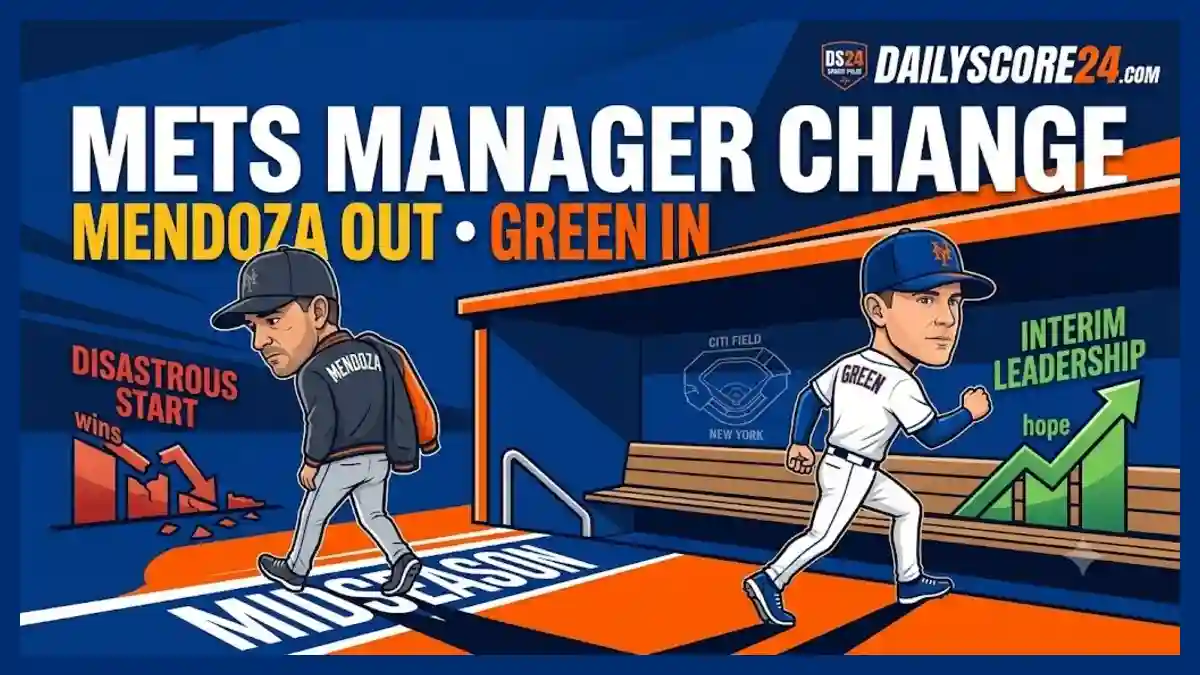
The front office dismisses Carlos Mendoza midseason as underperformance triggers immediate roster changes and Andy Green steps in.
Executive Turnaround: The Decision to Move on from Carlos Mendoza
The decision by the New York Mets front office to terminate manager Carlos Mendoza comes at a critical midpoint of the 2026 Major League Baseball season. Following a six-game losing streak that dropped the team to 13 games under a .500 winning percentage, the organization elected to make an immediate leadership change rather than waiting for the season to conclude. The dismissal marks the end of a three-season tenure characterized by stark performance polarization, moving from high postseason success to a steep multi-year decline.
David Stearns, the Mets President of Baseball Operations, organized a media briefing to address the club’s structural direction moving forward. Stearns emphasized that while organizational culture and personal relationships remained highly positive, the on-field results failed to match internal projections and historic financial investments. The front office determined that a managerial change was the necessary step to disrupt the team’s current downward trajectory and evaluate the remaining roster before the upcoming trade deadline.
Mets owner Steve Cohen also expressed his clear dissatisfaction with the current campaign through an official public release. Cohen highlighted that the fan base has high standards and that accountability remains paramount within the franchise. The owner underscored that despite substantial resource allocation, the team had fallen well short of its competitive benchmarks, prompting the front office to install an interim manager to oversee the final 81 games of the regular season.
Financial Analysis of the Historic Mets Payroll Luxury Tax 2026
The organizational pressure on the coaching staff is directly amplified by the franchise’s unprecedented financial landscape. The New York Mets entered the 2026 Major League Baseball season carrying an actual cash payroll of approximately $358 million, the highest opening-day figure across the major leagues. When calculating the Competitive Balance Tax (CBT) formulas, the team is currently projected to incur an additional $124 million penalty in luxury tax obligations, pushing their total financial commitment for the season close to half a billion dollars.
This historic spending profile means that every loss carries heightened financial and structural consequences for ownership. The high payroll baseline was designed to secure an immediate postseason return, rendering a last-place standing in the National League East entirely unacceptable to the executive board. With the luxury tax penalties compounding, the front office faces immense pressure to optimize roster efficiency, evaluate player contract valuations, and determine whether to initiate a comprehensive roster selloff or a strategic retooling.
Regarding the financial fallout of the managerial termination, the organization remains responsible for the remainder of the carlos mendoza contract salary. Mendoza originally signed a guaranteed three-year contract through the 2026 season with a club option for 2027. Because the team elected to decline the 2027 option and terminate the agreement early, ownership must absorb the remaining balance of his guaranteed salary, adding to an already complicated ledger that impacts future luxury tax calculations and team operations.
Technical Review of the Carlos Mendoza Managerial Record and Roster Challenges
A comprehensive examination of the final carlos mendoza managerial record reveals an initial period of high achievement followed by an extended period of performance stagnation. Mendoza concludes his tenure in Queens with a total regular-season record of 206 wins and 198 losses, yielding a career winning percentage of .510. While his cumulative record remains slightly above even, the trajectory over the last two calendar years demonstrates a severe regression from the high-water mark of his rookie managerial season.
+-----------------------------------------------------------+
|             CARLOS MENDOZA MANAGERIAL RECORD              |
+------+------------------+-------------+-------------------+
| Year | Regular Season   | Win %       | Postseason Result |
+------+------------------+-------------+-------------------+
| 2024 | 89–73            | .549        | Lost NLCS (LAD)   |
| 2025 | 83–79            | .512        | Missed Playoffs   |
| 2026 | 34–47            | .420        | Dismissed June 26 |
+------+------------------+-------------+-------------------+
| Total| 206–198          | .510        | 7–6 Postseason    |
+------+------------------+-------------+-------------------+
In 2024, Mendoza led a dramatic roster turnaround, guiding a struggling team through a historic late-season rally to secure a wild-card berth. The team advanced through the Wild Card Series and the National League Division Series, eventually falling just two wins short of a pennant in a six-game National League Championship Series against the Los Angeles Dodgers. However, the 2025 campaign saw the Mets start with excellent metrics before experiencing an extended second-half collapse to finish 83–79, entirely missing the postseason and initiating structural scrutiny.
The 2026 season exposed deeper systemic flaws, as the team struggled to find any sustained offensive or defensive rhythm. Injuries to foundational star players significantly limited tactical flexibility throughout the first 81 games. Core contributors including shortstop Francisco Lindor, infielder Marcus Semien, outfielder Luis Robert Jr., reliever Clay Holmes, and infielder Jorge Polanco all missed substantial durations on the injured list, depleting the roster’s depth and leaving the coaching staff without reliable replacements in high-leverage situations.
Tactical Evaluation and Mets Bullpen Decisions Criticism
Beyond roster injuries, specific strategic choices drew widespread scrutiny from fans, media networks, and former personnel. Prominent mets bullpen decisions criticism centered heavily on late-game pitching management, warm-up protocols, and the utilization of relief assets in non-traditional scenarios. Former Mets reliever Adam Ottavino publicly commented on the complex nature of the bullpen handling, highlighting friction regarding how relief pitchers were deployed during critical late-inning sequences.
The tactical disconnect became increasingly apparent during the team’s mid-June slump, where the bullpen blew multiple late-inning leads during a defining six-game losing streak. Analysts noted that the relief staff frequently appeared overextended or mismatched against opposing situational hitters, leading to a cascade of negative results that deflated team morale. These bullpen struggles directly contributed to the team falling 15 games behind the division-leading Atlanta Braves and 9.5 games out of the final National League wild-card spot.
The inability to protect leads fundamentally undermined the team’s competitive standing and hastened executive intervention. In modern baseball analytics, bullpen optimization is a critical variable in close-game outcomes and overall winning margins. When executive leadership observed that strategic adjustments were not yielding improved performance metrics, the responsibility shifted to the manager, making the bullpen’s instability a primary catalyst for the structural termination.
The Transition Plan: Andy Green Interim Manager Takes Control
To stabilize the club for the final 81 games of the regular season, the front office appointed Andy Green as the interim manager. Green, 48, has a deep background in professional baseball operations, having joined the New York Mets organization in 2023 as the Senior Vice President of Baseball Development. His familiarity with the franchise’s minor league pipeline, analytical systems, and player development strategies position him as a stable internal option to manage the immediate transition.
Green brings direct Major League Baseball managerial experience to the dugout, having previously managed the San Diego Padres from 2016 through 2019. During his four-season stint in San Diego, Green compiled a managerial record of 274 wins and 366 losses while navigating an extensive organizational rebuilding phase. As a former major league infielder who briefly appeared in four games as a player for the Mets back in 2009, Green understands the specific media environment and operational demands of the New York market.
+-----------------------------------------------------------+
|               ANDY GREEN MANAGERIAL HISTORY               |
+---------------+-------------------+-----------------------+
| Organization  | Role              | Tenure / Details      |
+---------------+-------------------+-----------------------+
| SD Padres     | Manager           | 2016–2019 (274–366)   |
| NY Mets       | SVP Baseball Dev. | 2023–2026             |
| NY Mets       | Interim Manager   | Appointed June 26     |
+---------------+-------------------+-----------------------+
The primary objective for Green will be to implement immediate tactical adjustments, restore accountability in the dugout, and evaluate which players fit into the organization’s long-term competitive plans. The front office has clarified that Green will hold the interim title for the remainder of the 2026 season, allowing the executive board ample time to conduct a thorough evaluation of internal performance metrics and broader industry options before naming a permanent long-term replacement.
Operational Outlook and Next Mets Manager Odds
The managerial vacancy has immediately ignited intense discussion across sports betting trends regarding who will permanently succeed Mendoza. Oddsmakers have quickly established the next mets manager odds for the upcoming offseason, featuring a mix of seasoned major league skippers, high-profile bench coaches, and internal analytical specialists. Because owner Steve Cohen possesses the financial resources to compete for elite tier talent, the opening is widely considered one of the most high-profile positions in professional sports.
The front office’s criteria for the next permanent manager will likely prioritize advanced analytical execution, proven bullpen management capabilities, and a demonstrated history of navigating high-pressure media markets. Until an official search begins in the winter, the executive team will monitor how the clubhouse responds to Green’s leadership style and structural changes. This interim period serves as a critical baseline for evaluating whether the team’s core issues require an external cultural overhaul or targeted roster adjustments.
Human Impact, Fan Engagement, and Citi Field Operations
The sudden midseason dismissal has had an immediate ripple effect on the fan community and stadium operations in Flushing. For a fan base that has not celebrated a World Series title since 1986, the 2026 midseason collapse represents a deeply frustrating chapter following the immense promise of the 2024 National League Championship Series run. The emotional variance has led to shifting attendance patterns and intense dialogue across local sports talk radio and fan forums.
Despite the current competitive hurdles, the organization is actively maintaining full stadium operations as the home calendar continues. Fans seeking to buy mets tickets citi field can access multiple promotional schedules, family packages, and premium seating arrangements through the official ticket box office. Roster adjustments and managerial transitions historically create unique windows for fans to observe emerging young prospects who receive increased playing time during the second half of a season.
The immediate competitive test for the restructured coaching staff arrives via the upcoming mets vs braves series schedule. Facing a highly competitive division rival forces Andy Green and his players into a high-intensity environment immediately following the organizational shakeup. How the team performs during this pivotal home series will set the tone for public perception, ticket demand, and corporate sponsorship impact throughout the summer months.
Broader Context and Comparative Analysis within Major League Baseball
The dismissal of Carlos Mendoza adds another entry to the complex history of midseason managerial changes within Major League Baseball. Historically, clubs carrying top-tier payroll configurations that find themselves well below the .500 mark at the midpoint of a season rarely exhibit patience. The front office’s action mirrors similar historical interventions where an immediate structural change was utilized to spark a underperforming roster and salvage corporate partner confidence.
A clear historical benchmark is the 2022 Philadelphia Phillies, who dismissed manager Joe Girardi after an unsatisfactory 22–29 start despite a substantial team payroll. Under interim manager Rob Thomson, the Phillies completely transformed their competitive approach, securing a wild-card berth and advancing all the way to the World Series. The Mets front office is clearly operating under the logic that an immediate administrative change can eliminate complacency and maximize the productivity of their highly compensated roster.
However, the structural challenges facing the 2026 Mets differ significantly due to the sheer volume of severe injuries to core star players. While a managerial change can optimize in-game tactics and bullpen configurations, it cannot instantly replace the offensive production of injured All-Stars like Lindor or Robert Jr. Therefore, the interim period under Andy Green will provide definitive data to David Stearns and Steve Cohen regarding whether the first-half failure was primarily a tactical coaching issue or a fundamental lack of healthy roster depth.
Stay sharp with Daily Score 24!