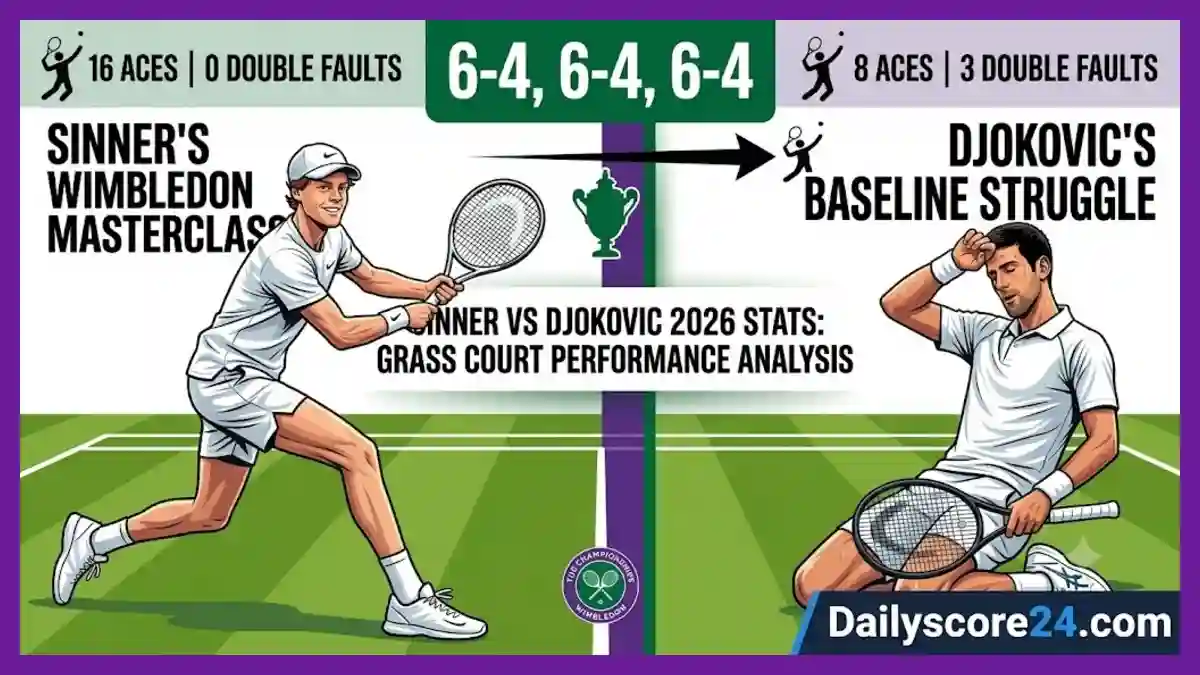
Masterclass Triumph: How Sinner vs Djokovic 2026 stats flipped a classic rivalry
Analytical breakdown of Jannik Sinner’s flawless straight-sets semifinal victory over Novak Djokovic on Centre Court.
The analytical breakdown of Sinner vs Djokovic 2026 stats redefines modern grass-court dominance after the world’s top players clashed on Centre Court. Examining the Wimbledon semifinal court metrics reveals how the defending champion neutralised a legendary opponent, while enthusiasts tracking Jannik Sinner tennis racket specifications and the updated Novak Djokovic head to head record focus on shifting technical paradigms. Critical grass court performance stats, including a detailed Sinner baseline winner breakdown contrasted with costly Djokovic unforced errors, have completely altered the tennis betting odds championship final configurations. As commentators launch into a comprehensive Sinner vs Zverev final preview, this structural milestone reshapes the entire modern Wimbledon men’s singles draw history.
The high-stakes encounter under the auspices of the All England Lawn Tennis and Croquet Club saw top seed Jannik Sinner deliver a flawless performance. Facing number seven seed Novak Djokovic, the young Italian required just two hours and 20 minutes to secure a 6-4, 6-4, 6-4 victory. The result marks a major turning point in professional tennis, directly impacting global sports broadcasting narratives and league media rights discussions.
Decoding the Sinner vs Djokovic 2026 Stats
A precise evaluation of the raw match data underscores how efficiently Sinner managed his service games and baseline rallies. The Italian fired 16 aces and committed zero double faults throughout the entire three-set match. This clinical display prevented Djokovic from establishing his trademark rhythm from the receiving end.
In contrast, Djokovic managed eight aces but was set back by three double faults at critical moments. While both players maintained nearly identical first-serve percentages—63% for Sinner and 62% for Djokovic—the disparity emerged once the ball was in play. Sinner won an astonishing 88% of his first-serve points, whereas Djokovic was limited to 75%.
The gap widened significantly on second-serve performance metrics. Sinner won 62% of his second-serve points, successfully landing 29 of 29 second deliveries. Djokovic found himself under constant pressure, winning just 41% of points behind his second serve, highlighting an area where his movement and depth lacked their usual accuracy.
| Match Metric | Jannik Sinner | Novak Djokovic |
| Final Score | 6-4, 6-4, 6-4 | 4-4, 4-4, 4-4 |
| Aces | 16 | 8 |
| Double Faults | 0 | 3 |
| First Serve Percentage | 63% | 62% |
| First Serve Points Won | 88% | 75% |
| Second Serve Points Won | 62% | 41% |
| Total Points Won | 103 | 81 |
| Break Points Converted | 3 / 13 | 0 / 1 |
Wimbledon Semifinal Court Metrics and Technical Demands
The physical environment of Centre Court played a decisive role in how the tactical battle unfolded between the baseline specialists. Sinner exploited the fast, low-bouncing nature of the grass to maximize his aggressive groundstrokes. His ability to take the ball early prevented his opponent from resetting the point.
Djokovic entered the match carrying physical fatigue from a grueling five-hour, five-set quarterfinal victory over Felix Auger-Aliassime. Though he did not appear outwardly hindered by the calf injury sustained during that round, the accumulated court mileage evidently slowed his lateral recovery. Sinner’s coaching team noted that the grass court parameters required immediate, microscopic adjustments to body positioning.
Equipment enthusiasts analyzing Jannik Sinner tennis racket specifications point out that his custom frame setup allows for immense ball plow-through without sacrificing control. Combined with his timing, this setup generated high ball speeds that routinely pushed Djokovic well behind the baseline. The resulting metrics show that Sinner covered less distance overall because his offensive positioning remained highly concentrated inside the court.
Shifting Paradigms in the Novak Djokovic Head to Head Record
This semifinal victory marks a significant chapter in the long-running rivalry between the two generational talents. With this straight-sets triumph, Sinner continues a notable run of form against the 24-time Grand Slam champion. The victory avenges previous defeats and establishes a new benchmark for matchups on fast surfaces.
Reflecting on the match, Sinner shared his perspective on the ongoing rivalry. “It means a lot that I can play one more final here,” Sinner stated during his post-match interview. “It’s the most special tournament we have. What Novak is still doing is amazing. We always have tough matches, the last one he won in the semis in Australia, so I tried to make a couple of adjustments.”
The loss complicates Djokovic’s pursuit of a record-equalling eighth title at the historic London tournament. At 39 years old, the Serbian legend faced a younger opponent executing near-flawless performance analytics. Analysts note that while Djokovic remains competitive against the broader tour, solving Sinner’s current tactical formula presents an evolving challenge.
Analyzing the Sinner Baseline Winner Breakdown
A deep dive into the rally structures reveals how the top seed systematically broke down the opposition from the back of the court. Sinner accumulated 40 total winners over the course of the three sets, with a large portion coming from his backhand wing. His crosscourt backhand repeatedly forced Djokovic into defensive, stretched positions.
In the first set, deadlocked at 4-4, Sinner created two break opportunities with a sharp crosscourt backhand retrieval. Although he missed an initial smash volley, he converted the second chance with a clean backhand winner down the line. This single break defined the pattern for the subsequent sets.
Sinner also showed exceptional efficiency at the net, winning seven out of eight net approaches in the opening frame alone. By blending a heavy baseline weight of shot with timely forward movement, the Italian never allowed Djokovic to settle into long, rhythmic baseline exchanges.
Unpacking the Djokovic Unforced Errors
While Sinner performed at an elite level, Djokovic struggled to find consistency during the high-pressure moments of the match. The Serbian star faced 13 break points across his 12 service games, a testament to the persistent pressure applied by Sinner’s return positioning. Djokovic managed to save 10 of those break points to keep the scoreline respectable.
Conversely, Djokovic earned only a single break point chance during the entire contest, which arrived at 2-1 in the third set. Sinner promptly snuffed out the opportunity with a 133mph ace, illustrating his mental composure. The lack of clean looks on return compounded the pressure on Djokovic’s own service games.
The match concluded on a missed overhead from Djokovic, wrapping up a contest defined by subtle but decisive execution gaps. The statistical reality showed that Djokovic hit far more service points in total—105 compared to Sinner’s 79—meaning his service games were significantly more taxing.
Grass Court Performance Stats and Financial Implications
The structural shift at the top of men’s tennis has immediate ramifications for commercial sponsorship impact and player contract valuation metrics. Corporate brands heavily tied to individual athletic longevity are reallocating resources toward the rising generation of stars. Sinner’s flawless run reinforces his position as a primary target for luxury sportswear and technical equipment endorsements.
The data gathered from this semi-final provides sports scientists with invaluable performance analytics regarding movement on worn grass. As the tournament progresses into its final weekend, the baseline areas of Centre Court have become slicker, demanding precise footwork. Sinner’s zero-slip performance indicates superior adaptation to these changing environmental variables.
From a macro perspective, professional tennis continues to see evolving viewership patterns. Broadcasters monitoring global sports betting trends reported immense engagement with live micro-betting markets during the match. The steady 6-4, 6-4, 6-4 progression offered a stable environment for real-time statistical tracking.
Sinner vs Zverev Final Preview and Betting Landscape
With the semifinal matches concluded, attention shifts directly to the upcoming championship match. Sinner, the defending champion, will face number two seed and reigning French Open champion Alexander Zverev on Sunday. Zverev earned his spot in the final by defeating Arthur Fery in a synchronized performance earlier in the day.
The updated tennis betting odds championship final indicate that Sinner enters the match as the statistical favorite. His unbroken serving streak and high percentage of points won on first serve make him a formidable hurdle on grass. However, Zverev’s recent success on clay and strong baseline metrics suggest a highly tactical final.
This matchup represents a classic battle between the top two seeded players in the world. Tennis historians note that a final of this caliber provides substantial data for the Wimbledon men’s singles draw history, cementing the transition into a distinct new competitive era.
Stay sharp with Daily Score 24!