Fallout Stuns Studio as ESPN Sports Personality Talent Cuts Claim Analyst
Network restructuring and asset consolidation trigger sudden on-air exits following Disney corporate shifts.
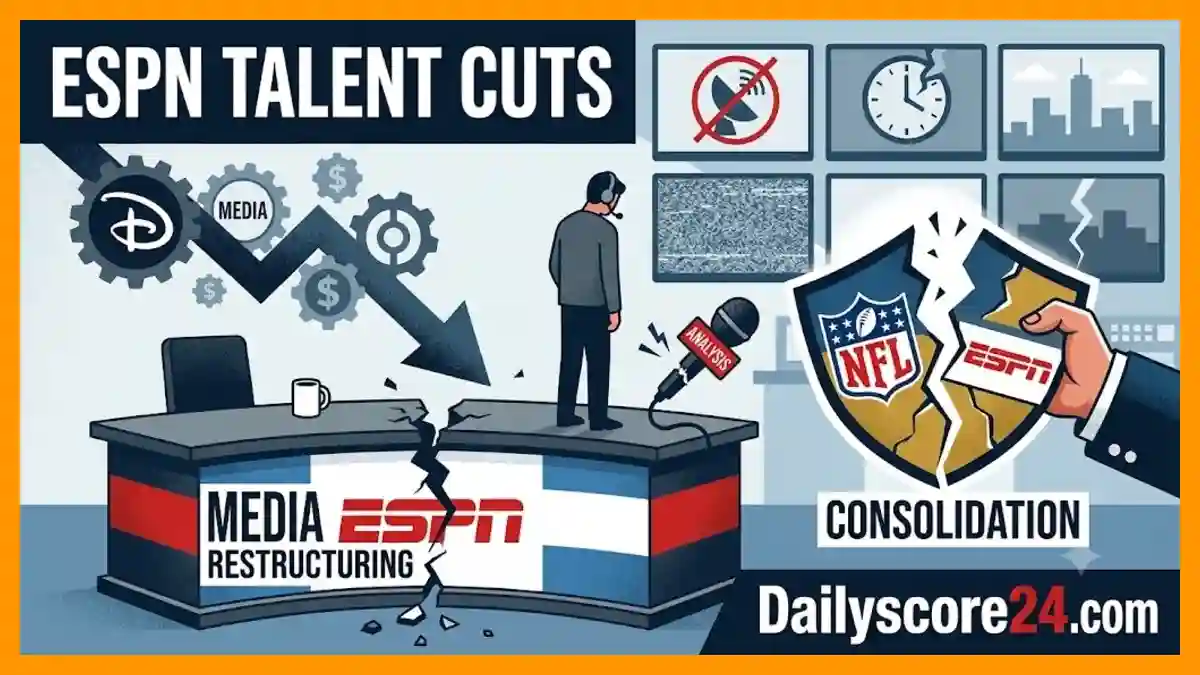
The recent espn sports personality talent cuts reflect a major disney broadcast network lay offs update as media executives evaluate broadcasting operations. Central to this wave is analyst Ryan Clark, whose ryan clark espn salary breakdown at $2 million annually underscored significant financial commitments amid sports media executive job restructuring. As cord-cutters examine how to watch sportscenter without cable, network shifts follow new espn nfl network acquisition terms that created operational overlaps. This shift impacts the broader sports journalism employment market, verified through an andrew marchand athletic report analysis detailing on-air network changes.
Broadcast operations at The Walt Disney Company and ESPN experienced immediate structural shifts following initial reports from Bristol, Connecticut. The removal of high-profile studio talent marks a transitional phase for network programming leading into upcoming premier league broadcasts and championship events. Industry executives continue to align linear television budgets with emerging digital platforms.
Overview of ESPN Sports Personality Talent Cuts and Studio Transitions
The ongoing espn sports personality talent cuts materialized abruptly during live studio programming at the network’s Bristol headquarters. Former National Football League safety Ryan Clark was informed of his departure while on set during a broadcast of NFL Live. Following the notification, Clark did not complete the remainder of the television program.
According to reports, executives altered the notification schedule after external media inquiries threatened to publicize the move prior to direct communication. The network had originally planned to conduct personnel notifications on Tuesday morning. Decision-makers accelerated the process to ensure the analyst was informed directly by corporate leadership rather than through public reporting.
Clark originally joined the network in 2015 following a 13-year professional football career that included a Super Bowl XLIII championship with the Pittsburgh Steelers. Over nine years, he developed into a primary studio figure across Monday Night Countdown, Get Up, and SportsCenter. His sudden departure leaves a notable vacancy in network programming as preparations continue for Super Bowl LXI.
┌────────────────────────────────────────────────────────────────────────┐
│                   ESPN TALENT TRANSITION TIMELINE                      │
├────────────────────────────────────────────────────────────────────────┤
│ 2015: Ryan Clark joins ESPN following retirement from the NFL.         │
│ 2024: Signs contract extension valued at approximately $2M per year.   │
│ Feb 2026: Disney completes $3B transaction for NFL Media assets.       │
│ July 2026: On-air talent cuts begin during live "NFL Live" broadcast.  │
└────────────────────────────────────────────────────────────────────────┘
Analysis: Integration Mechanics Under ESPN NFL Network Acquisition Terms
The underlying driver behind current workforce adjustments stems from the finalized espn nfl network acquisition terms. Disney completed a $3 billion transaction to acquire NFL Media assets, including NFL Network, RedZone, and digital properties. In exchange, the National Football League secured a 10 percent equity stake in ESPN.
This corporate integration created operational redundancies across production, technical, and talent rosters. Roles previously maintained independently by NFL Network in Los Angeles and ESPN in Connecticut now fall under a unified corporate management umbrella. Executives are actively streamlining operations to eliminate duplicated job functions across studio shows.
“Today’s announcement paves the way for the world’s leading sports media brand and America’s most popular sport to deliver an even more compelling experience for NFL fans,” stated Robert A. Iger, Chief Executive Officer of The Walt Disney Company, regarding the asset transaction.
The absorption of NFL Media staff into ESPN created an expanded roster of analysts and commentators. As contracts come up for renewal or evaluation, management has prioritized balance-sheet consolidation. The integration strategy focuses heavily on direct-to-consumer digital delivery while reducing linear studio overhead.
Financial Breakdown: Ryan Clark ESPN Salary Breakdown and Roster Contracts
Examining the ryan clark espn salary breakdown reveals the scale of top-tier talent investments prior to current restructuring initiatives. Clark signed a contract extension in 2024 that paid him an estimated $2 million annually. That agreement positioned him among the higher-compensated studio analysts within the network’s football division.
Rising executive scrutiny surrounding compensation structures reflects broader market recalibrations across broadcast television. Networks are increasingly weighing fixed talent costs against measurable viewability metrics and digital subscriber acquisition. High-earning analysts face elevated evaluation standards during periods of corporate cost reduction.
| Metric / Asset Component | Detailed Verified Figure | Operational Significance |
| Annual Contract Value (Ryan Clark) | ~$2,000,000 per year | High-tier studio analyst compensation baseline |
| NFL Media Asset Valuation | $3,000,000,000 | Total fair value of absorbed digital & linear assets |
| NFL Equity Stake in ESPN | 10.0% | Equity consideration granted to league owners |
| ESPN Overall Valuation | $30,000,000,000 | Baseline corporate valuation implied by league deal |
| Acquired Live Regular Season Games | 7 additional matchups | Expands total live NFL game slate to 28 games |
Roster management dynamics in sports media parallel player contract valuation models used in professional leagues. Media companies analyze salary cap-style budgets to balance marquee personalities against production overhead. High-value contracts are frequently re-evaluated when network strategies pivot toward automated or centralized studio operations.
Analysis: Impact on the Sports Journalism Employment Market
Developments in Bristol reflect wider macroeconomic pressures across the sports journalism employment market. Linear television networks face declining traditional cable bundle revenues, prompting aggressive shifts toward direct-to-consumer streaming products. Consequently, talent budgets are being reallocated toward exclusive live event broadcasting rights rather than studio commentary.
An andrew marchand athletic report analysis highlighted that on-air personalties and behind-the-scenes staff across both ESPN and NFL Network are affected by this consolidation wave. These cuts follow previous workforce reductions, including the dismissal of roughly 30 production employees earlier in the calendar year.
Talent Reallocation: Networks favor flexible contributors capable of appearing across digital, audio, and linear platforms without requiring separate contractual structures.
Historical Context: Similar broadcast talent realignments occurred in previous years, involving prominent figures such as Robert Griffin III, Sam Ponder, and Zach Lowe.
Digital Pivot: Capital allocation is shifting toward direct-to-consumer technology architecture and exclusive live sports rights acquisitions.
Reporting by Richard Deitsch of Sports Business Journal confirmed that network leadership sought to manage the timing of public announcements to minimize operational disruption. Meanwhile, media analyst Bobby Burack noted that external inquiries accelerated the public release of personnel changes.
How to Watch SportsCenter Without Cable and Access Direct-to-Consumer Broadcasts
As traditional cable networks restructure, sports fans frequently inquire about how to watch sportscenter without cable during transitional programming periods. The migration of sports content to streaming services has altered how linear broadcasts reach consumer audiences. Cord-cutters currently utilize several multi-channel video programming distributors (MVPDs) and direct streaming options:
Live TV Streaming Bundles: Services such as YouTube TV, Hulu + Live TV, Fubo, and Sling TV carry linear feeds of ESPN, ESPN2, and SEC Network.
Direct-to-Consumer (DTC) Platforms: ESPN’s integrated DTC application incorporates live studio shows, regional game broadcasts, and absorbed NFL Network feeds.
Standalone Digital Subscriptions: Select league packages, including NFL+, provide mobile access to local live games and studio coverage.
┌────────────────────────────────────────────────────────────────────────┐
│                   CORD-CUTTING ACCESS ARCHITECTURE                     │
├────────────────────────────────────────────────────────────────────────┤
│ [Cable Feed] ───> Multi-Channel Live Bundles (YouTube TV / Hulu)      │
│ [NFL Assets] ───> ESPN Direct-To-Consumer (DTC) Unified Application     │
│ [Studio News] ───> Digital Standalone Portals (NFL+ / Digital Apps)    │
└────────────────────────────────────────────────────────────────────────┘
The ongoing integration of RedZone and NFL Network into ESPN’s direct-to-consumer ecosystem provides subscribers with consolidated viewing packages. This transition eliminates the need for separate league-specific linear cable subscriptions.
Human Impact and On-Air Transformation Across Sports Television
Behind corporate restructuring metrics lie substantial personal and professional transitions for broadcast personnel. On-air analysts, technical directors, studio crew members, and booking producers face sudden employment changes when network lineups shift. These adjustments ripple through production hubs in Bristol, Connecticut, and Los Angeles, California.
For athletes transitioning into media, high-profile studio roles represent a demanding secondary career path. Analysts must navigate live television demands while managing public commentary across social channels and independent podcasts. When network priorities realign, on-air talent must rapidly adapt to changing media landscapes.
Fan communities also experience notable shifts in viewing routines when familiar studio personalities are replaced. Long-running studio programs rely on established chemistry between hosts and former players. Personnel changes alter panel dynamics on flagship shows such as NFL Live and Monday Night Countdown.
What the Data Shows: Future Outlook for Network Media Rights
Corporate realignments in sports media are heavily influenced by shifting revenue streams across league media rights, sponsorship impact, and sports betting trends. As leagues negotiate multi-billion dollar rights deals, networks prioritize live game inventory over non-exclusive studio programming. Live games deliver reliable rating spikes that command premium advertising rates.
Performance analytics and real-time betting integration have become standard components of modern sports broadcasts. Media companies are reallocating production budgets toward interactive graphics, statistical overlays, and integrated wagering data. This technical pivot reduces reliance on traditional narrative studio desks in favor of data-driven studio segments.
Sponsorship dollars are increasingly tied to multi-platform delivery. Advertisers demand direct attribution through streaming applications and digital video channels rather than linear commercial breaks alone. As ESPN and Disney expand their direct-to-consumer ecosystem, corporate structure will continue reflecting digital-first commercial priorities.
Stay sharp with Daily Score 24!