The Financial Masterclass Behind the Famous Bobby Bonilla contract
An in-depth analysis of the New York Mets deferred money list, historical precedents, and luxury tax implications under 2026 MLB regulations.
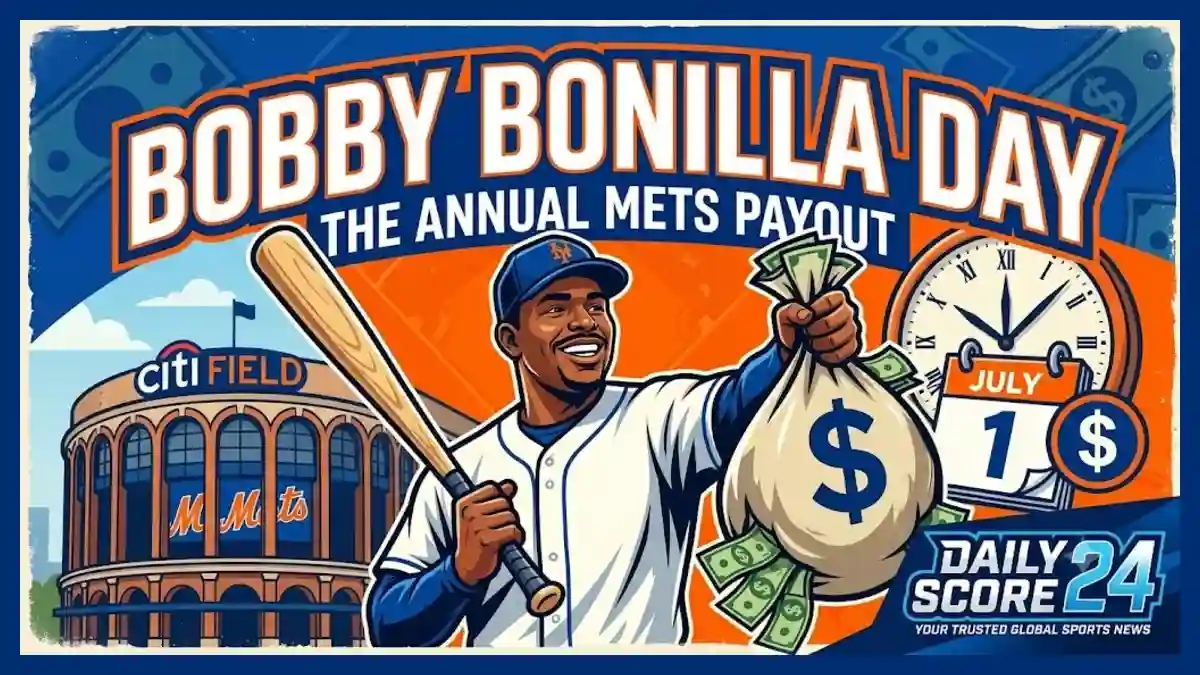
The July 1 arrival of ‘Bobby Bonilla Day‘ highlights the Bobby Bonilla contract breakdown 2026, explaining why this financial milestone remains critical to team payroll mechanics. To evaluate how much does Bobby Bonilla make today, fans track the New York Mets deferred money list, which also holds the Bret Saberhagen Mets contract payout details. Compounded by a fixed 8% Bobby Bonilla buyout interest rate, the deal directly impacts competitive roster spending under MLB deferred contracts luxury tax rules. This framework invites intense fan scrutiny when weighed as the Shohei Ohtani contract vs Bobby Bonilla, showcasing how the Chris Davis Orioles deferred payment schedule and other legacy allocations redefine modern front-office strategy.
When the New York Mets management bought out Bonilla’s remaining contract at the conclusion of the 1999 Major League Baseball season, former owner Fred Wilpon opted against an immediate lump-sum payment. Instead, the front office structured an annuity strategy intended to free up short-term financial resources for roster building at Citi Field. Today, this legacy calculation functions as a template for modern front offices, including the Los Angeles Dodgers, who navigate long-term obligations to maximize immediate competitive balance windows.
The Core Mechanics: Bobby Bonilla Contract Breakdown 2026
On Wednesday, July 1, 2026, the New York Mets issued their 16th consecutive annual payment of exactly $1,193,248.20 to former outfielder Bobby Bonilla. This scheduled transaction marks another milestone in an arrangement that has become a permanent fixture of the baseball calendar, long after Bonilla last played an active Major League game in October 2001. The origins of the deal trace back to the end of the 1999 season when the Mets chose to release the veteran, who was still owed $5.9 million on his standard player contract.
Rather than executing an immediate cash buyout, Bonilla’s agent, Dennis Gilbert, negotiated a structured deferral that delayed any compensation for over a decade. Under the terms of the final settlement, the initial $5.9 million principal was locked away until 2011, accumulating substantial interest during the deferral period. By stretching the payment timeline across a 25-year window running from 2011 through 2035, the total payout will ultimately close at nearly $30 million by the time the final check is delivered.
Inside the New York Mets Deferred Money List and Historical Precedents
While public attention converges heavily on Bonilla every July, he is not an isolated entry on the New York Mets deferred money list. The franchise established a distinct operational pattern for long-term buyouts during the late 1990s and early 2000s, often seeking to defer immediate payroll requirements to circumvent active financial pressures. A prime example of this methodology is found in the Bret Saberhagen Mets contract payout details, which served as the operational prototype for the larger Bonilla arrangement.
Saberhagen, a former Cy Young Award winner, collects $250,000 annually from the Mets under a 25-year arrangement that commenced in 2004 and is scheduled to conclude in 2028. The administrative logic driving both the Bonilla and Saberhagen structures was deeply intertwined with the financial landscape of the Wilpon ownership era. The front office aimed to shield capital from current payroll considerations to facilitate immediate free-agent signings, intending to offset future payout liabilities through high-yield investment structures managed by third-party securities operations.
Mathematical Reality of the Bobby Bonilla Buyout Interest Rate
The mathematical engine behind the annual $1.19 million payment is the negotiated 8% Bobby Bonilla buyout interest rate. When a franchise chooses to delay a guaranteed payment, the union dictates that the principal must grow to reflect the time value of money. Because the Mets negotiated an 11-year gap between Bonilla’s release in 2000 and his first installment in 2011, the compound interest significantly expanded the baseline debt obligations of the organization.
| Contract Element | Metric Details |
| Original Owed Principal (1999) | $5,900,000.00 |
| Negotiated Annual Interest Rate | 8.00% |
| Payment Start Date | July 1, 2011 |
| Payment End Date | July 1, 2035 |
| Annual Payout Amount | $1,193,248.20 |
| Total Cumulative Payout | $29,831,205.00 |
This specific payment architecture demonstrates how standard player contract valuations expand exponentially when high fixed interest rates are sustained over multiple decades. The resulting annuity guarantees that Bonilla continues to earn a salary that exceeds the active league minimum for players currently on 40-man rosters, highlighting the long-term fiscal consequences of historical front-office negotiations.
Comparative Analysis: Shohei Ohtani Contract vs Bobby Bonilla
The continuous discussions surrounding legacy agreements reached a new peak following recent market developments, most notably highlighted by the Shohei Ohtani contract vs Bobby Bonilla. While Bonilla’s contract represents a retroactive veteran buyout designed to remove an aging player from the roster, Ohtani’s historic $700 million agreement with the Los Angeles Dodgers uses massive future deferrals as an active free-agency strategy. Ohtani receives just $2 million annually during his 10 active seasons with the club, deferring $680 million to be paid out between 2034 and 2043.
The underlying motivations between the two eras reveal distinct approaches to player contract valuation. Bonilla’s camp maximized future returns at the end of a career, while Ohtani utilized deferrals to lower his team’s present-day payroll calculations, allowing the Dodgers to sign additional elite talent without exceeding penalizing luxury tax thresholds. Agent Nez Balelo noted that long-term arrangements have fascinated the public for decades, yet modern structures prioritize immediate on-field flexibility over deferred cash conservation.
Legacy Portfolios: Chris Davis Orioles Deferred Payment Schedule
The practice of pushing financial obligations into the future extends well beyond the National League East. The Chris Davis Orioles deferred payment schedule stands as one of the most substantial modern examples of an organization managing a prolonged post-retirement payout. Following a contract restructuring surrounding his retirement from the Baltimore Orioles, Davis is compensated through a framework that manages a total of $42 million in deferred salary, ensuring financial disbursements that continue through the 2037 championship season.
Other notable franchises navigate similar legacy liabilities for retired stars. For example, the Boston Red Sox concluded a prolonged financial chapter with Manny Ramirez, whose deferred package paid out millions over an extended period. These cases emphasize that deferred compensation is an established mechanism across Major League Baseball, used by front offices to balance the immediate competitive mandates of fan communities with long-term capital allocations.
Regulatory Framework: MLB Deferred Contracts Luxury Tax Rules
To prevent large-market teams from exploiting future payouts to stack current rosters unchecked, the league enforces strict MLB deferred contracts luxury tax rules. Under the rules of the Competitive Balance Tax (CBT), a player’s contract payroll hit is not determined solely by their current cash earnings. Instead, the league calculates the present-day value of deferred money by discounting it against the prevailing federal prime rate at the time the contract is signed.
This system ensures that teams face an accurate accounting of their long-term spending against the established 2026 base luxury tax threshold of $244 million. If an organization exceeds this line, they are subjected to tiered penalty rates starting at 20% for first-time offenders, rising to 30% for a second consecutive year, and escalating to 50% or more for chronic spending. Consequently, managing the present value of legacy contracts remains a vital operational focus for executives aiming to protect draft selections and avoid steep financial surcharges.
Stay sharp with Daily Score 24!