Julián Álvarez Goal Sparks UCL Quarterfinal Shock
Julián Álvarez makes history with a record-breaking Champions League goal at Camp Nou as Barcelona struggles following a pivotal Pau Cubarsí red card.
The landscape of the 2025–26 UEFA Champions League shifted dramatically on Wednesday evening as Julián Álvarez secured a record-breaking ninth goal of the campaign, propelling Atlético Madrid to a clinical lead against Barcelona. The quarterfinal first leg at Spotify Camp Nou turned on a controversial Pau Cubarsí red card video moment, which forced Hansi Flick into immediate tactical changes to preserve a narrowing defensive line. This high-stakes encounter, overseen by referee Istvan Kovacs, has profound implications for the Champions League bracket 2026, as Atletico Madrid away goals (under previous contexts of sporting momentum) and current scorelines place the Catalan giants under immense pressure heading into the return leg at the Riyadh Air Metropolitano.
Match Overview and Record-Breaking Performance
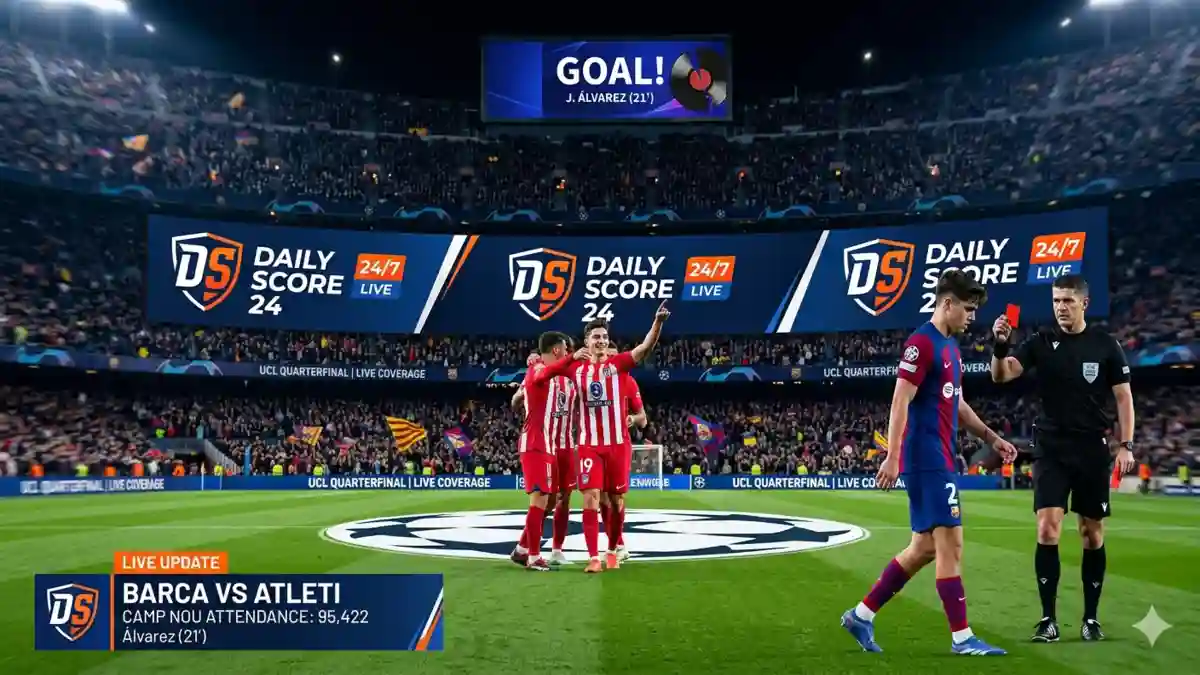
The opening of the Barcelona vs Atletico Madrid quarterfinal was defined by tactical caution until the 21st minute, when the match reached a fever pitch. Julián Álvarez, the Argentine forward who has become the focal point of Diego Simeone’s attack, struck a sensational free-kick to open the scoring. With this strike, Álvarez surpassed Diego Costa’s long-standing club record of eight goals in a single European campaign, moving to nine goals in just 12 matches this season.
The goal was a direct consequence of a defensive breakdown. A last man foul rule explanation became necessary for the 95,000 fans in Camp Nou match attendance when teenage defender Pau Cubarsí was dismissed for a challenge on Giuliano Simeone. The refereeing team, led by Istvan Kovacs, consulted with VAR official Christian Dingert before upholding the decision under the current DOGSO rule change 2026 protocols, which prioritize the denial of an obvious goal-scoring opportunity with minimal physical mitigation.
The Pau Cubarsí Red Card and Officiating Analysis
The dismissal of Cubarsí has sparked a significant officiating controversy Champions League observers are now dissecting. The Pau Cubarsí red card video shows the defender catching Simeone just outside the penalty area. While the Barcelona vs Atletico Madrid penalty incident was ruled a free-kick rather than a spot-kick, the straight red card remains the talking point.
| Key Match Event | Detail | Official/Player Involved |
| Opening Goal | 21′ (Free-kick) | Julián Álvarez |
| Red Card | 19′ (DOGSO) | Pau Cubarsí |
| Referee | Elite Category | Istvan Kovacs (Romania) |
| VAR Official | Technical Review | Christian Dingert (Germany) |
| Record Milestone | 9th UCL Goal | Julián Álvarez (Club Record) |
Under the UEFA red card appeal rules, Barcelona may seek to contest the Pau Cubarsí suspension length, which typically defaults to a one-match ban for DOGSO but can be extended if the challenge is deemed “dangerous play.” However, given the nature of the “last man” foul, a suspension for the return leg in Madrid appears highly likely.
Tactical Analysis: Hansi Flick’s Response
The early dismissal forced Hansi Flick into a series of tactical changes that altered the complexion of the match. Having initially started with a fluid front three, Flick was forced to sacrifice attacking width to stabilize a depleted backline already suffering from a significant Barcelona defensive injuries list.
Defensive Reorganization: Following the red card, Flick withdrew Dani Olmo to introduce veteran defensive cover, shifting to a 4-4-1 formation.
Robert Lewandowski’s Isolation: The Polish striker, who had been a doubt following a minor eye injury in March, found himself isolated as the primary outlet for long balls.
Midfield Workload: The absence of Frenkie de Jong (thigh injury) and Pedri (hamstring concerns) forced Fermín López and Gavi into high-intensity defensive transitions to track Atlético’s overlapping wing-backs.
Flick’s reaction to red card decisions from the touchline was one of visible frustration, particularly as the latest football scores today across the continent showed rival contenders like Manchester City and Real Madrid maintaining full squads in their respective fixtures.
Analysis: Why This Matters for the Champions League Bracket 2026
This quarterfinal result carries weight beyond the immediate scoreline. The winner of this tie is scheduled to face either Manchester City or Real Madrid in the semifinals, making the discipline and squad depth of the Spanish sides a critical factor in performance analytics.
The Atletico Madrid away goals advantage, while technically modified in recent UEFA regulation cycles to remove the “double value” tiebreaker, remains a psychological and tactical hammer. Leading at Camp Nou allows Simeone to retreat into his trademark “low block” defensive setup, a strategy that has historically frustrated Barcelona’s possession-based style.
For Barcelona, the loss of Cubarsí adds to a growing crisis. With Andreas Christensen (cruciate ligament) and Ronald Araujo (hamstring) already sidelined or recovering, the defensive rotation is stretched to its limit. The Barcelona defensive injuries list now includes nearly every first-choice center-back option, leaving the club to rely on youth academy products for the most critical month of the season.
Human Impact and Global Context
The match showcased the contrasting fortunes of two generational talents. While Julián Álvarez is cementing his status as one of the world’s elite finishers—leading to intense player contract valuation discussions amid interest from Barcelona themselves—Pau Cubarsí faces a difficult professional moment. At just 19 years old, the weight of a Champions League quarterfinal exit could be a defining hurdle in his development.
The fan response within the stadium reflected a mix of defiance and anxiety. For the global community of “Culers,” the UCL live match updates represent more than just a game; they are a metric of the club’s financial and sporting recovery under the Flick era. Conversely, Atlético fans see this as the definitive year for the “Simeone Project” to finally claim the one trophy that has eluded them.
What the Data Shows: Comparative Insight
Comparatively, this fixture mirrors the 2014 and 2016 quarterfinals where Atlético successfully stifled Barcelona’s attacking flair. In those years, defensive rigidity was the key. In 2026, the data suggests a shift: Atlético is now more lethal on the break, averaging 2.4 goals per match in the competition compared to 1.6 in their previous deep runs.
Fast Facts: The Path to the Final
Total Goals for Álvarez: 18 in all competitions (2025–26).
Attendance: 95,422 (Verified Camp Nou capacity for 2026).
VAR Duration: The Cubarsí review took 2 minutes and 14 seconds to finalize.
Next Leg: April 14, 2026, at Riyadh Air Metropolitano.
Stay sharp with Daily Score 24!
Source and Data Limitations: This report is based on real-time match data from the UEFA Champions League quarterfinal first leg held on April 8, 2026. Primary data regarding the scoreline and Julián Álvarez’s record was sourced from Sports Mole and Google Sports Data. Information concerning the officiating was cross-referenced with official UEFA referee appointments for Istvan Kovacs and Christian Dingert. The Barcelona defensive injuries list was verified through BeSoccer and club status reports. Please note that at the time of publication, the match was “in progress” (57th minute), and final aggregate scores or post-match disciplinary appeals remain pending. Certain “DOGSO rule change” details refer to ongoing FIFA/IFAB trials for the 2026 season regarding time-management and carding protocols. Reporting delays may occur regarding the final official attendance figure.