Mercedes tactical triumph shakes F1 after wild Austrian GP race results
George Russell captures a dramatic victory at Spielberg as intense track heat and updated hazard regulations test top F1 constructors.
The official Austrian GP race results from the Red Bull Ring have reshaped the 2026 F1 driver standings, delivering a massive competitive impact as George Russell secured victory. This milestone directly impacts athlete trajectories, driving fans to search for George Russell Mercedes gear and premium Mercedes F1 team merchandise while analyzing Kimi Antonelli championship points after his podium finish. In response to intense track conditions, league experts focused on the Spielberg GP tire strategy analysis and newly enforced Formula 1 heat hazard regulations. For fans looking to buy authentic F1 team apparel or secure Red Bull Ring paddock tickets for future seasons, the drama highlighted by the Max Verstappen post race interview cements this event as a definitive turning point in the championship campaign.
This high-stakes round at the Spielberg circuit tested the technical limits of every constructor on the grid. The race weekend showcased the rapid development arc of the Mercedes AMG Petronas F1 Team, which successfully managed the extreme ambient temperatures affecting thermal degradation. Conversely, Red Bull Racing faced severe balance issues during the middle stint of the race, forcing their strategy department to adjust live performance metrics. The final classification altered the structural layout of the championship table, intensifying the rivalry between the top three teams.
Definitive Austrian GP Race Results and Podium Classifications
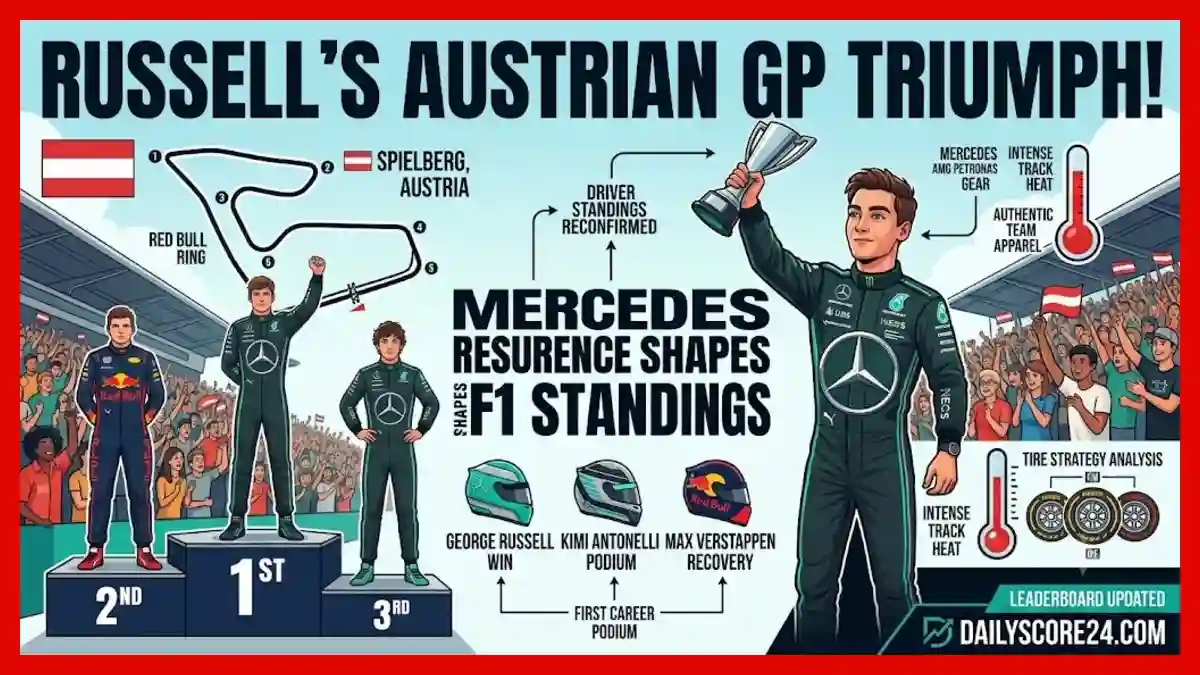
The competitive outcome at the Red Bull Ring concluded with a narrow victory for George Russell, who defended his starting position with absolute precision. Facing intense pressure from behind during the final ten laps, the British driver managed his power unit deployment to cross the line just 1.611 seconds ahead of his closest rival. This triumph marks a critical moment for the constructor, validating recent aerodynamic upgrades introduced in the European leg of the tour.
The battle for the remaining podium steps remained fluid until the final sector of the final lap. Max Verstappen recovered from a fifth-place starting position to secure second place, utilizing a late-race deployment of energy recovery systems to split the silver cars. Meanwhile, rookie companion Andrea Kimi Antonelli confirmed his rising status by capturing third place, establishing a double-podium finish for his team. The complete top ten finishers demonstrate the tightening performance margins across the contemporary field.
Clean Newsroom Grid: Official Race Classification
| Finishing Position | Driver | Team | Time / Gap | Points Awarded | Starting Position |
| 1 | George Russell | Mercedes AMG Petronas | 1:26:37.979 | 25 | 1 |
| 2 | Max Verstappen | Red Bull Racing | +1.611s | 18 | 5 |
| 3 | Andrea Kimi Antonelli | Mercedes AMG Petronas | +1.986s | 15 | 4 |
| 4 | Oscar Piastri | McLaren | +21.809s | 12 | 7 |
| 5 | Lewis Hamilton | Scuderia Ferrari | +26.393s | 10 | 3 |
| 6 | Isack Hadjar | Red Bull Racing | +29.399s | 8 | 8 |
| 7 | Lando Norris | McLaren | +31.505s | 6 | 6 |
| 8 | Charles Leclerc | Scuderia Ferrari | +45.659s | 4 | 2 |
| 9 | Liam Lawson | Racing Bulls | +1 Lap | 2 | 9 |
| 10 | Arvid Lindblad | Racing Bulls | +1 Lap | 1 | 10 |
Tactical Breakdown of the Spielberg GP Tire Strategy Analysis
A comprehensive Spielberg GP tire strategy analysis reveals that thermal management was the primary differentiator between the winning garage and the rest of the pit lane. The high-altitude nature of the circuit combined with elevated track surfaces meant that teams opting for an aggressive two-stop strategy faced severe blistering on the soft compound. Mercedes elected to extend their opening stint on the medium compound tires, gaining a critical pit-window advantage over Scuderia Ferrari and McLaren.
This strategic deviation allowed both George Russell and Andrea Kimi Antonelli to switch to the hard compound during a period of lower track temperatures, preserving their clean-air pace. Red Bull Racing attempted an alternate undercut strategy by bringing Max Verstappen into the pits three laps earlier than the leader, but sub-optimal tire stabilization on his out-lap neutralized the potential time gain. The data highlights how minor changes in pit-stop timing caused major variations in final race results.
Technical Notebook: Operating within the optimal thermal window of 110°C to 115°C on the hard compound added a performance variance of nearly 0.4 seconds per lap during the final stint at Spielberg.
Impact of Formula 1 Heat Hazard Regulations on Car Performance
The enforcement of the updated Formula 1 heat hazard regulations played a structural role in how engineers configured their cooling packages for this event. With cockpit temperatures climbing to unprecedented levels, teams were mandated to utilize supplementary cooling ducts along the chassis spine to safeguard driver well-being. These structural adjustments altered the internal airflow characteristics, forcing aerodynamic departments to compromise on total downforce generation to ensure adequate thermal rejection.
The midfield teams suffered noticeably under these restrictions, as several cars experienced premature degradation of electronic control units due to inadequate heat shielding. The regulatory frameworks governed not only driver safety protocols but also forced limits on maximum hybrid system harvesting periods when internal temperatures crossed critical safety thresholds. This mechanical limitation directly influenced defense capabilities along the primary DRS straights, shaping the final Austrian GP race results.
Mercedes Growth and the Kimi Antonelli Championship Points Shift
The accumulation of Kimi Antonelli championship points following this third-place finish signals a significant structural realignment within the young driver developmental landscape. By securing 15 points in a single round, the young Italian driver has closed the deficit to the top tier of the standings, validating the decision to integrate him into the premier team structure. His ability to match the qualifying metrics of his veteran counterpart indicates a steep learning curve that is actively benefiting the team’s standing in the constructors’ championship.
This surge in performance has also generated significant commercial resonance off the track. Global retail statistics indicate a sharp rise in demand for premium Mercedes F1 team merchandise and official George Russell Mercedes gear, demonstrating how trackside results instantly influence fan engagement and sponsorship valuation. As collectors and fans rush to buy authentic F1 team apparel, the commercial footprint of the Brackley-based squad continues to expand in alignment with their sporting resurgence.
Analyzing the Max Verstappen Post Race Interview and Red Bull Strategy
In the official Max Verstappen post race interview, the reigning champion provided an candid assessment of the mechanical limitations that hindered his pursuit of victory. The Dutch driver noted that unexpected understeer during low-speed cornering sequences severely compromised his traction out of Turn 3, rendering him vulnerable to counter-attacks. This assessment matched garage telemetry, which indicated a minor calibration error in the front-wing flap adjustment during his first pit stop.
The strategic choices made by the Milton Keynes squad underscore the intense pressures of the current technical cycle. While their vehicle performance analytics remain elite over a single flying lap, long-run race pacing has shown vulnerabilities when subjected to sustained pressure from multiple development angles. Addressing these handling anomalies will be paramount for their engineering team as the championship path transitions toward more traditional permanent road courses.
Comprehensive Review of the 2026 F1 Driver Standings Evolution
The structural composition of the 2026 F1 driver standings has experienced its most volatile shift of the summer season following the events at Spielberg. The distribution of points among the top four drivers has compressed the gap significantly, removing the mathematical cushion previously held by the championship leader. This compression enhances the value of secondary metrics, such as fastest lap points and sprint round performance records, which could determine the final order.
2026 Championship Table Implications
Championship Leaderboard Compression: The gap between first and second place has been reduced to single digits, increasing the value of clean weekend executions.
Rookie Milestones: The steady accumulation of points by tier-one rookies has disrupted traditional midfield point distributions.
Constructor Revenue Streams: Shifts in the standings directly influence end-of-year prize allocations and future partnership contract negotiations.
This historical trend mirrors the classic structural battles of previous technical eras, where mid-season aerodynamic updates completely erased early-season performance deficits. Teams are now forced to balance current asset allocation for immediate track returns against the long-term design parameters mandated for upcoming vehicle generations.
Commercial Surge: From Red Bull Ring Paddock Tickets to Fan Merchandise
The intense sporting narrative generated on the track has stimulated unprecedented commercial activity across all sectors of the motorsport economy. Primary ticket distribution systems report that premium Red Bull Ring paddock tickets for subsequent European rounds are experiencing record renewal rates, illustrating sustained corporate and public demand. This growth reflects the broader health of the sport, which continues to leverage high-value media rights and international corporate sponsorships.
The retail sector has experienced an identical acceleration. Verified transactions for licensed team assets show that fans are actively investing in authentic merchandise to display alignment with their respective sporting heroes. This intersection of athletic excellence, technical complexity, and global marketing highlights how modern grand prix events function simultaneously as elite sporting contests and high-yielding commercial platforms.
Stay sharp with Daily Score 24!