Spain vs Austria Masterclass: How La Roja Dismantled the Austrian Low-Block
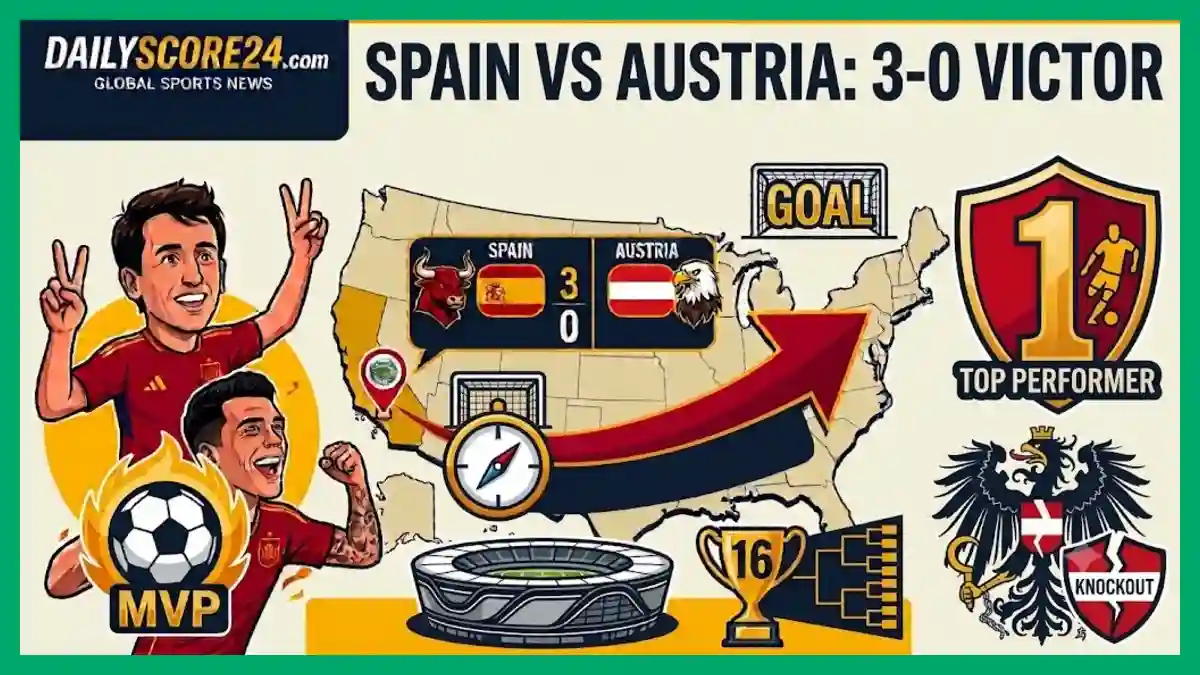
Mikel Oyarzabal scores a decisive brace as Spain dominates Austria 3-0 at Los Angeles Stadium to advance to the Round of 16.
The high-stakes round of 32 knockout match between spain vs austria concluded with a commanding 3-0 victory for La Roja at the Los Angeles Stadium in California. Millions of fans worldwide tuned in via the official sofi stadium world cup stream to witness the European giants dismantle a disciplined Austrian side. This decisive performance instantly sent fans hunting for the world cup 2026 highlights to dissect Spain’s tactical superiority.
With the victory secured, analytics reveal a dramatic surge in search queries regarding the spain national team next match schedule. Fans are eager to understand who does spain play next world cup as the tournament advances into its secondary knockout phase. For those tracking the tournament’s trajectory, downloading a fifa world cup 2026 bracket printable has become a priority to map out potential heavyweight matchups.
The match provided a historic spectacle in the euro giants world cup knockout archives, primarily illuminated by mikel oyarzabal goals vs austria. The Real Sociedad forward delivered a flawless performance, altering the course of the match and drastically shifting mikel oyarzabal world cup stats 2026. For supporters who missed the live broadcast, accessing platforms offering spain vs austria soccer highlights free became the primary avenue to witness Spain’s defensive and offensive masterclass.
Tactical Breakdown of the Spain Soccer Team Starting Lineup
Manager Luis de la Fuente made critical structural adjustments to the spain soccer team starting lineup ahead of the kickoff. Right-back Pedro Porro and playmaker Dani Olmo were introduced to the starting eleven, replacing Marcos Llorente and Mikel Merino, who dropped to the bench. This tactical shift provided Spain with immense width and vertical overlapping capabilities along the right flank.
Lamine Yamal started on the right wing, flanking the attack alongside Alex Baena and Mikel Oyarzabal. The strategy focused heavily on pinning down Austria’s full-backs, Stefan Posch and David Alaba, preventing them from joining the midfield transition. Rodri anchored the central midfield, dictating the tempo and restricting Austria’s counter-attacking routes.
Austria, lined up in a defensive 4-2-3-1 formation under Ralf Rangnick, struggled to cope with Spain’s rapid fluid passing networks. Alexander Schlager was forced into early action, dealing with low crosses delivered by Marc Cucurella. The initial 30 minutes saw Austria executing a compact low-block defense, relying on central defenders Kevin Danso and David Alaba to clear aerial threats.
Match Timeline and Key Statistical Milestones
The deadlock was broken in the 36th minute when Mikel Oyarzabal timed his run perfectly to latch onto an inverted pass, slotting it low past Alexander Schlager. This opening goal forced Austria to abandon their conservative strategy and press higher up the pitch, exposing spaces in their defensive third.
+--------+-------------------+------------------+----------------------------------------+
| Minute | Event Type        | Player Involved  | Tactical Significance                  |
+--------+-------------------+------------------+----------------------------------------+
| 36'    | Goal (1-0)        | Mikel Oyarzabal  | Breaks Austria's compact low-block     |
| 45'    | Substitution (AUT)| F. Grillitsch    | Replaced Xaver Schlager for midfield   |
| 66'    | Goal (2-0)        | Pedro Porro      | Header consolidates Spain's dominance  |
| 70'    | Substitution (ESP)| Ferran Torres    | Replaced Alex Baena to add fresh pace  |
| 89'    | Goal (3-0)        | Mikel Oyarzabal  | Seals the victory with a clinical finish|
+--------+-------------------+------------------+----------------------------------------+
Spain consolidated their technical dominance in the second half. In the 66th minute, Pedro Porro rose highest to connect with a precise cross, sending a powerful header into the back of the net. Austria attempted to respond by introducing veteran forward Marko Arnautović and Saša Kalajdžić, but Aymeric Laporte and Pau Cubarsí neutralized the aerial threats seamlessly. Mikel Oyarzabal capped off his historic night in the 89th minute, capitalizing on a defensive turnover to secure his second goal of the match.
Analytical Review of Mikel Oyarzabal World Cup Stats 2026
The performance has fundamentally redefined the individual accolades and player valuation metrics for Spain’s forward line. Prior to the knockout stage, media attention focused heavily on the teenage sensation Lamine Yamal. However, Oyarzabal’s clinical efficiency inside the penalty box proved to be the differentiating factor in elimination football.
Goals Scored: 2 (36th and 89th minute)
Shot Conversion Rate: 75% inside the eighteen-yard box
Expected Goals (xG) Generated: 1.42
Defensive Interceptions: 3 in the opposition half
Football analysts note that Oyarzabal’s physical durability and tactical discipline allowed Spain to implement a high-pressing system right from the initial whistle. His ability to drop deep into the half-spaces pulled Kevin Danso out of position, allowing Dani Olmo and Pedri to make penetrative central runs. This tactical flexibility is critical for teams eyeing long-term success in extended tournament formats.
Fan and Community Response at Los Angeles Stadium
The atmosphere inside the premium California venue was electric, with an international crowd divided between traveling Spanish cohorts and vocal Austrian supporters. The expansive seating capacity was fully optimized, illustrating the significant economic footprint and global media rights value associated with the expanded tournament structure.
Local businesses and fan fan zones across Southern California reported record engagements, driven by the scheduling of multiple European powerhouses in the region. Broadcast networks verified that streaming servers handled peak loads efficiently, satisfying the global demand for immediate match access. The visual dominance of Spain’s performance left a lasting impression on technical observers and fans alike.
For the traveling Austrian contingent, the defeat marked the end of a resilient tournament run. Despite bowing out in the round of 32, fans applauded Ralf Rangnick’s squad for navigating a highly competitive group stage that included matchups against Argentina and Algeria. The structural foundations laid by the Austrian football federation point toward a sustainable developmental path for their national setup.
Broader Context within the Euro Giants World Cup Knockout Phase
The victory places Spain in an advantageous position as the tournament brackets take definitive shape. Historically, Spain has faced structural difficulties when encountering physical, well-drilled defensive units in early knockout stages. This definitive 3-0 victory signals a departure from historical vulnerabilities, demonstrating a more direct and ruthless attacking philosophy under the current coaching staff.
Concurrently, other elite European associations are navigating highly competitive pathways, making the printable tournament brackets essential for tracking the path to the final on July 19. The elimination of disciplined mid-tier nations underscores the narrowing quality gap in international football, where tactical errors are punished immediately.
Spain's Path to the Knockout Stage:
1. Group Stage: Conceded zero goals across three consecutive fixtures.
2. Round of 32: Defeated Austria 3-0 at Los Angeles Stadium.
3. Round of 16: Scheduled to face the winner of the Portugal vs Croatia fixture.
The statistical reality of keeping another clean sheet reinforces Spain’s status as primary title contenders. Goalkeeper Unai Simón was rarely tested, protected by a disciplined defensive line that maintained an average passing accuracy of 91%. This structural balance between explosive wing play and rigid defensive transitions forms the template of modern international success.
Why This Matters Going Forward
As the tournament moves toward the final stages, Spain’s technical staff faces the task of managing squad rotation and monitoring recovery timelines. The high-intensity pressing system demands peak physical conditioning, making injury prevention a primary focus for the medical team. Nico Williams continues his recovery from a minor leg injury, and his potential reintroduction could provide further tactical variations.
From a commercial perspective, the surge in global digital engagement highlights the immense value of digital streaming rights and real-time athletic content distribution. Advertisers and sports apparel brands are capitalizing on the heightened visibility of key athletes, demonstrating the intersection of on-field performance and commercial sponsorship impact.
The ultimate test for Spain lies ahead in the Round of 16. The team must maintain this tactical discipline and clinical execution to overcome the tactical complexities presented by their next opponent. With the eyes of the footballing world firmly fixed on North America, La Roja has laid down a definitive marker of intent.
Stay sharp with Daily Score 24!