
A WNBA Triumph: The Tactical Legacy Behind the Angel Reese Rebound Record
Atlanta Dream forward breaks a historic league milestone in a dominant performance against the Indiana Fever frontcourt.
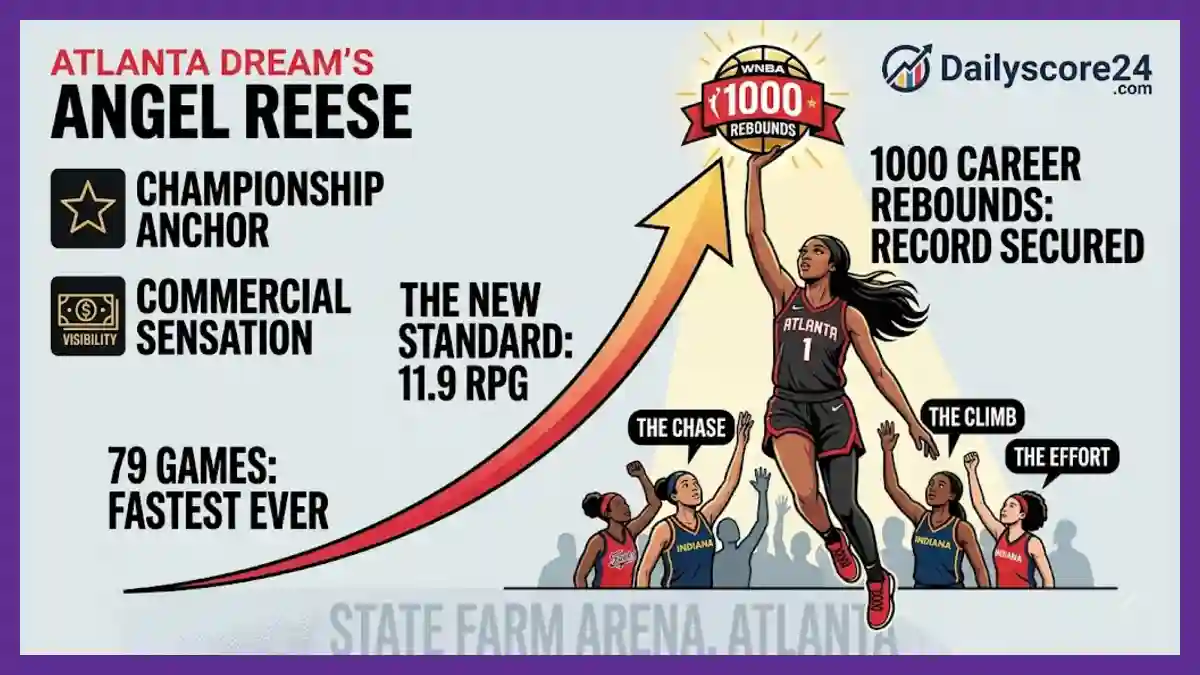
The historic angel reese rebounding record wnba milestone was reached on June 20, 2026, as the forward became the fastest player to 1000 rebounds in league history during Atlanta’s 113-96 blowout victory. Looking closely at the angel reese stats vs fever, she logged 18 points and eight rebounds, shattering the previous tina charles rebounding record by reaching the mark in just 79 games. This feat has skyrocketed her angel reese rookie card value and established her among the wnba all time rebounding leaders. Fans rushing to secure an angel reese jersey authentic edition are also closely analyzing the updated atlanta dream roster stats 2026 data.
This performance has profound implications across the professional women’s basketball landscape. For the Atlanta Dream, the achievement solidified a dominant regular-season performance and places them in a tie for the second-best record in the league. For individual accolades and sports marketing, it underscores Reese’s unprecedented efficiency on the boards, driving ticket availability spikes and high fan engagement across major markets.
The Historic Milestone: Fastest Player to 1000 Rebounds
The moment of history arrived with 4:29 remaining in the third quarter at State Farm Arena. Angel Reese secured a defensive board that officially marked her 1,000th career rebound in the Women’s National Basketball Association (WNBA). By achieving this feat in her 79th career appearance, she cleared the previous benchmark by a wide margin. Basketball Hall of Fame candidates and historic legends have historically taken far longer to reach this milestone, proving her immediate adaptation to the physical demands of elite professional play.
Reese finished the matchup with 18 points and eight rebounds, helping guide the Atlanta Dream to a decisive 113-96 victory over the visiting Indiana Fever. This game was played in front of a sold-out crowd of 17,044 fans at the home of the NBA’s Atlanta Hawks, a major upgrade from the Dream’s regular Gateway Center Arena capacity of 5,000. The massive shift in venue directly reflects the soaring commercial interest in the league’s high-profile rivalries.
The achievement has already begun to recalibrate data tracking and performance analytics across sports networks. Scoring efficiency often dominates traditional sports journalism headlines, but elite possession control through defensive and offensive rebounding represents the true foundational baseline for championship contenders. Reese’s historic pace shifts the conversation around individual defensive value and highlights how modern forwards influence the game without relying strictly on high-volume perimeter shooting.
Analyzing the Fastest Player to 1000 Rebounds
To truly appreciate the significance of this milestone, one must look at how Reese compares to historical legends. Tina Charles previously held the record by reaching 1,000 boards in 89 games, meaning Reese cleared the record by an astonishing 10 games. Currently leading the WNBA with an average of 11.9 rebounds per game this season, Reese has turned possession tracking into a precise art form. Her ability to read ball trajectories off the rim gives the Dream an elite edge in second-chance points.
The structural tracking of her career milestones demonstrates remarkable game-to-game consistency across multiple seasons. Rather than relying on sporadic, high-volume performances against weaker frontcourts, her numbers show an even distribution of production against the league’s elite interior defenders. This relentless consistency has made her one of the most reliable anchors in modern women’s basketball.
Milestone Comparison: Games to 1,000 Rebounds
| Player Name | Team Affiliation | Games Required |
| Angel Reese | Atlanta Dream | 79 |
| Tina Charles | Connecticut Sun (Historical) | 89 |
| Sylvia Fowles | Minnesota Lynx (Historical) | 94 |
| Candace Parker | Los Angeles Sparks (Historical) | 95 |
Note: Data accounts for modern era tracking and represents verified regular-season performances across WNBA history.
The data indicates that Reese is operating at a pace completely distinct from her historical peers. Averaging double-digit boards from the very inception of a professional career requires a unique blend of physical conditioning, positioning intuition, and elite durability. By maintaining this trajectory, she has placed herself on a direct path to challenge career records long thought untouchable by modern frontcourt standards.
How the Strategy Fueled the Fastest Player to 1000 Rebounds
Critics have occasionally pointed out that Reese generates a portion of her rebounding numbers by collecting her own missed shots around the rim. However, deep-dive performance analytics show that her offensive crashing creates significant positive value for the entire roster. By forcing opposing defenses to commit multiple bodies to the paint, she frees up perimeter space for guards like Rhyne Howard and Allisha Gray, who scored 24 and 22 points respectively during the contest.
The strategic layout employed by the Atlanta coaching staff emphasizes floor spacing that maximizes Reese’s operational radius. When the ball goes up, the Dream design clear weak-side lanes that allow her to track down errant long-range bounces. This spatial coordination makes it incredibly difficult for opponents to execute clean box-outs, particularly during high-tempo transitions.
“I think people don’t realize rebounding is harder than you think,” Reese remarked during her post-game press conference. “Defensive rebounds are a little bit easier than going in and crashing every single time to give a second-chance opportunity on the offensive end.” This focus on offensive execution has drastically altered how teams prepare to face the Dream’s frontcourt rotation.
Furthermore, this interior presence forces opposing centers into early foul trouble, shifting the entire game flow. During the third quarter against Indiana, Atlanta leveraged this exact pressure to compile a decisive 28-15 run. By converting interior stops directly into fast-break opportunities, the Dream turned a minor halftime deficit into a comfortable double-digit cushion that completely deflated the Fever’s defensive game plan.
Collectibles and the Fastest Player to 1000 Rebounds
The immediate ripple effects of this historic achievement have extended far beyond the court. In the sports memorabilia market, verified assets related to the forward have experienced unprecedented valuation adjustments. The collectible card market, in particular, has seen transaction volumes spike as professional collectors react to the milestone, driving interest in rare editions and certified rookie variations.
Retail indicators also reflect this surging demand, with authentic jerseys experiencing rapid sell-outs across official e-commerce platforms. Merchandising executives note that achieving historic milestones early in an athlete’s career creates a highly sustainable consumer base. This commercial momentum directly impacts corporate sponsorship evaluations and media rights discussions across the broader sports industry.
Rookie Card Valuation: High-grade insert cards have seen intense secondary market demand following the record-breaking game.
Merchandise Velocity: Authentic apparel orders surged regionally in the United States, Canada, and Australia immediately following the broadcast.
Sponsorship Leverage: Corporate partnerships are increasingly factoring in historic statistical achievements for long-term brand campaigns.
This commercial ecosystem creates a self-reinforcing loop of visibility and financial growth for the sport. As casual collectors realize the historical weight behind Reese’s performance, the economic footprint of the entire league expands. This trend provides concrete evidence that individual statistical excellence can serve as a primary driver for institutional revenue and mainstream market penetration.
Community Response to the Fastest Player to 1000 Rebounds
The cultural significance of the matchup was visibly evident in the stands at State Farm Arena. High-profile figures from across sports and entertainment, including South Carolina women’s basketball coach Dawn Staley, NBA players Jalen Johnson and C.J. McCollum, and Grammy-nominated singer Latto, were all present to witness the historic moment. Staley received a standing ovation from the crowd while watching seven of her former collegiate players compete on the court.
For local communities, the presence of elite role models performing at a historic level provides massive inspiration for youth development programs. The expansion of the game’s footprint into larger NBA venues allows thousands of young athletes to experience professional women’s sports at an elite scale. The energy within the stadium demonstrated that the modern fan base values tactical excellence and rebounding toughness just as much as high-scoring perimeter play.
“You can look statistically, not just for my shots, but for my teammates’, it gives us more points, it gives us more opportunities,” Reese explained when addressing the media. “Just being able to go out and do what I do every single night just shows my consistency.” This dedication to fundamental consistency serves as an impactful case study for sports development programs worldwide.
The localized economic impact on the city of Atlanta also deserves recognition, as consecutive sell-outs generate massive hospitality and retail revenue. By proving that women’s basketball can consistently draw over 17,000 fans to an NBA-sized arena, players like Reese and Indiana’s Caitlin Clark are actively redefining the commercial viability of professional women’s sports in major metropolitan areas.
Where Reese Stands Among the WNBA All-Time Rebounding Leaders
While Reese has established herself as the fastest player to reach the 1,000-rebound threshold, the journey into the upper echelons of the all-time leaderboard requires sustained health and multi-year longevity. Legendary figures like Sylvia Fowles, Tina Charles, and Candace Parker spent over a decade dominating the low post to secure their spots at the top of the historical record books. Reese’s current trajectory, however, places her well ahead of their respective career timelines.
The evolution of defensive schemes over the decades makes her modern production even more impressive. Historical rebounders often operated in a highly condensed paint area, whereas modern style dictates a spaced floor with long rebounds bouncing out to the perimeter. Adapting to these unpredictable bounce patterns requires a high degree of athletic flexibility and rapid spatial processing.
Evaluating this performance against historical benchmarks reveals the true scale of her achievement. Reese is not merely breaking records; she is setting an entirely new standard for frontcourt efficiency that will challenge the next generation of athletes. As the league continues to expand its schedule and physical demands, maintaining this exact level of elite output will remain the ultimate test of her career.
The intersection of individual accolades and team success remains the ultimate metric for long-term greatness. While the individual milestone is undeniable, Reese’s focus remains squarely on capturing a league championship with the Atlanta Dream. By pairing her historic individual production with a winning culture, she is cementing an enduring legacy that will be analyzed by sports historians for decades to come.
Stay sharp with Daily Score 24!


