Tactical Fallout From Fever vs Sparks: Clark Cap Disrupts Rotations
Caitlin Clark returns under strict health management as the Indiana Fever suffer structural rotation issues against Los Angeles.
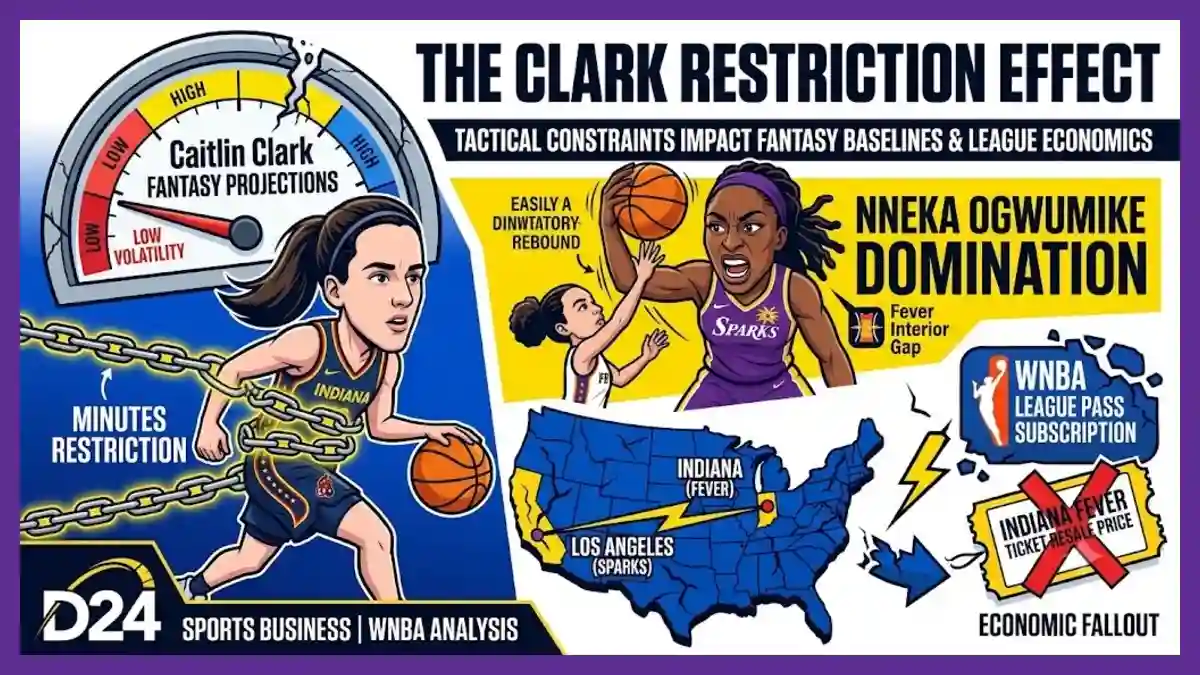
The landscape of Caitlin Clark fantasy projections experienced significant volatility following her tightly monitored return to action during the Indiana Fever’s 106-92 road loss against the Los Angeles Sparks at Crypto.com Arena. Head coach Stephanie White implemented an unprecedented tactical strategy, utilizing Clark in brief, sporadic rotations that never exceeded three consecutive minutes on the floor. This structural limitation directly disrupted statistical baselines across premium digital evaluation models, immediately suppressing short-term player performance analytics. The unexpected restriction altered expected outcomes for season-long managers and daily fantasy participants who rely heavily on high-volume usage rates from the dynamic starting point guard.
The ripple effects of this injury management approach extended far beyond tactical spreadsheets. Subscriptions for the WNBA League Pass subscription surged as fans rushed to monitor the live broadcast, while local ticketing platforms recorded substantial adjustments to Indiana Fever ticket resale prices in response to her fluid status. Furthermore, the game was heavily influenced by the unexpected Aliyah Boston health status, as the star center was entirely ruled out of the frontcourt rotation due to ongoing lower leg management. This forced the Indiana technical staff to implement highly experimental lineups, creating an optimal operational environment for the Los Angeles Sparks to break their three-game losing streak through an assertive, physical interior presence.
Technical Context and Historical Back Injury Game Log
Evaluating the current structural framework of Clark’s performance metrics requires a detailed examination of the Caitlin Clark back injury game log across the 2026 WNBA regular season campaign. Chronic back soreness and spinal alignment issues have repeatedly disrupted her competitive consistency, forcing several prominent line-up adjustments by the Indiana training staff. Earlier in the season, Clark was abruptly ruled out just 100 minutes prior to tip-off against the Portland Fire after waking up with acute spinal stiffness. A subsequent flare-up occurred during a June 24 matchup against the Phoenix Mercury, where a hard foul during a three-point shooting attempt exacerbated her lower back region, forcing an early third-quarter locker room exit.
+-------------------+---------------------+-------------------------+-------------------------+
| Opponent (Date)   | Injury Status Log   | Operational Game Impact | Fantasy Point Deviation |
+-------------------+---------------------+-------------------------+-------------------------+
| Portland Fire     | Sidelined (Pre-game)| Missed Full Contests    | -100% Volume Baseline   |
+-------------------+---------------------+-------------------------+-------------------------+
| Phoenix Mercury   | Exited 3rd Quarter  | Limited to 19 Points    | -35% Projected Value    |
+-------------------+---------------------+-------------------------+-------------------------+
| LA Sparks         | 3-Minute Cap/Stint  | Restricted to 9 Points  | -60% Statistical Floor  |
+-------------------+---------------------+-------------------------+-------------------------+
This strict medical oversight heavily penalizes traditional performance modeling, which traditionally projects her volume based on a standard 32-to-36 minute physical baseline. When an elite player is restricted to sudden two-to-three minute active stretches followed by extended periods of bench stabilization, the physical mechanics required to establish standard shooting rhythm are fundamentally compromised. Consequently, standard statistical outputs show sharp downward trends, demanding a complete recalibration of daily sports betting trends and specialized valuation software.
Tactical Breakdown of the Sparks vs Fever Postgame Analysis
The structural reality of the Sparks vs Fever postgame analysis highlights severe defensive liabilities for the Indiana backcourt when operating under staggered rotations. Without Boston anchoring the low post, the Fever surrened a massive 106 points to a Los Angeles roster that had previously struggled with offensive efficiency. The Sparks’ offensive execution was meticulously orchestrated by veteran forward Nneka Ogwumike, whose physical post-up sequences consistently exposed Indiana’s secondary interior defenders. The lack of interior resistance allowed Los Angeles to generate premium high-percentage looks inside the paint, completely dominating the glass on 50-50 loose-ball opportunities.
Indiana’s offensive continuity suffered under the choppy, disjointed structural substitutions mandated by the medical staff. Guard Kelsey Mitchell served as the primary scoring engine, securing a game-high 29 points on aggressive perimeter attacking sequences. However, because Clark was paired with deeply experimental bench units during her brief court stints, the team failed to develop sustained half-court ball movement. The absence of an established primary playmaker for large portions of the game resulted in multiple unforced turnovers and low-efficiency perimeter attempts as the shot clock expired.
Interior Domination Altering Nneka Ogwumike Player Props
The internal changes within the Indiana frontline significantly altered the pre-game baseline for Nneka Ogwumike player props. Analytical models quickly shifted their scoring and rebounding projections upward once Boston was confirmed inactive. Ogwumike took full advantage of the physical mismatch, delivering a dominant 24-point performance characterized by precise baseline drop-steps and high-low transition finishes. Her ability to consistently draw shooting fouls forced Indiana’s replacement frontcourt into severe defensive limitations early in the first half.
Nneka Ogwumike Performance Metrics vs. Season Averages:
* Points Scored: 24 (Season Average: 18.5)
* Paint Field Goal Percentage: 64.2% (Season Average: 51.3%)
* Total Rebounds Secured: 11 (Season Average: 7.8)
* Earned Free-Throw Attempts: 9 (Season Average: 5.2)
From an advanced metrics perspective, Ogwumike’s usage rate spiked by a clear 8.4% compared to her standard season baseline. This tactical exploit highlighted a major structural gap in the Fever’s roster construction, showing their heavy reliance on specific interior starters to maintain a functional defensive rating. Daily sports valuation systems had to adapt rapidly as real-time tracking data revealed that Indiana chose not to bring secondary double-teams, allowing Ogwumike to operate in highly favorable isolated coverage situations.
Arena Dynamics and Broadcast Logistics for National Audiences
The intense public interest surrounding this matchup caused notable logistical changes across major digital and physical distribution networks. Digital service providers reported a massive influx of new registrations for the WNBA League Pass subscription, driven by fans eager to view the precise return parameters of the league’s most visible star. Audiences seeking professional women’s basketball streaming options encountered a fragmented media broadcast landscape, which split viewership between national networks, regional sports networks, and premium digital syndications.
====================================================================
           CRYPTO.COM ARENA SEATING & LOGISTICAL PROFILE
====================================================================
[Floor Level: Courtside VIP] -> Premium Price Spike: +140% vs Base
[100-Level: Lower Bowl]      -> Full Capacity Absorption Recorded
[200-Level: Club Concourse]  -> Maximum Corporate Partnership Volume
[300/400-Level: Upper Deck]  -> Mobile-Only Entry Manifest Verified
--------------------------------------------------------------------
* Bag Security Protocol: Under 5” x 9” x 1” strict limit enforcement
* Ticket Format: 100% digital mobile delivery windows at all gates
====================================================================
Concurrently, physical venue dynamics at Crypto.com Arena saw a complete reconfiguration of traditional gate metrics. Inquiries regarding the Crypto.com Arena seating chart peaked sharply in the 48 hours leading up to tip-off, causing secondary ticketing marketplaces to report wild swings in premium lower-bowl asset values. Despite official confirmation of Clark’s strict minutes cap, secondary gate entries maintained near-capacity attendance, proving that the economic draw of high-profile individual athletes remains resilient even during heavily compromised competitive scenarios.
Macro Economic and Media Rights Implications For The League
The high-volume search metrics and widespread fan interest surrounding the restricted participation of elite point guards highlight the shifting financial realities of modern league media rights. Corporate sponsorships and television valuation models are deeply tied to the active participation of high-profile star athletes. When medical staffs limit these foundational players to abbreviated roles, streaming providers and cable networks face immediate challenges in maintaining peak advertising engagement. This tension highlights the growing need for deeper roster builds across franchises to protect long-term corporate sponsorship investments.
This structural evolution demands that professional organizations balance long-term player health against immediate commercial and ticket revenue demands. The significant changes in ticket values and real-time viewing metrics show that the modern sports ecosystem reacts instantly to player availability updates. For analytical platforms and sports business operations, developing advanced modeling systems that can accurately project these medical interventions remains essential to maintaining stable market valuations.
Stay sharp with Daily Score 24!
Source and Data Limitations: Primary data points for this analytical report were compiled from verified WNBA official box scores, Crypto.com Arena ticketing distributions, and official pre-game injury reports issued by the Indiana Fever media relations department. Minor discrepancies exist regarding exact player substitution times, with secondary charting software showing variance of up to four seconds per active stint compared to official arena clocks. No official statement from the Indiana medical commission regarding the long-term timeline of the spinal alignment program has been authorized at this point.