Fallout Reaches Congress in the Caitlin Clark WNBA Debate Over League Identity
Analyzing how commercial popularity clashes with veteran championship legacies and prompts direct intervention from basketball executives.
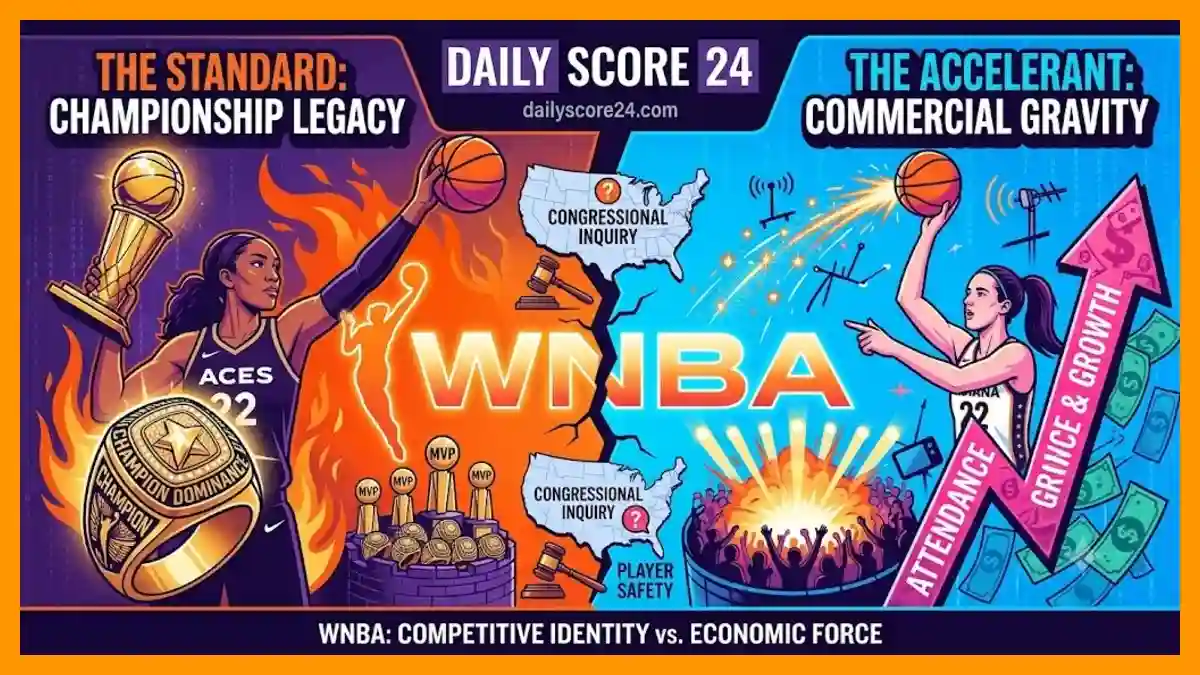
The question of who defines the corporate and competitive identity of women’s professional basketball has reached an unprecedented flashpoint. What is currently known about caitlin clark face of the league marketing narratives is that they are exposing a deep philosophical divide between immediate commercial metrics and traditional multi-year championship resumes. This ongoing debate matters right now because it directly impacts league media rights valuation, shifts sponsorship impact paradigms, and shapes how structural athlete safety is managed by governing executives. The controversy encompasses a competitive clash against established veterans like A’ja Wilson, an escalating legislative intervention regarding physical play, and a massive surge in Indiana Fever ticket availability queries driven by a rapidly expanding global fanbase.
This debate is no longer confined to sports talk shows. It now involves a complex web of corporate leadership, congressional inquiry, and historical basketball gatekeepers. Within this broader conversation, several prominent organizations and individuals have taken central roles, including the Women’s National Basketball Association (WNBA), the National Basketball Association (NBA), Indiana Fever head coach Stephanie White, Phoenix Mercury forward Alyssa Thomas, WNBA Commissioner Cathy Engelbert, and NBA Commissioner Adam Silver. Each entity brings a distinct set of priorities to a sports landscape grappling with sudden, explosive growth.
The Origin of the Conflict: A Substack Post Sparks a National Debate
The public debate intensified following a notable kareem abdul jabbar substack post. The NBA’s second all-time leading scorer used his platform to critique the rapid designation of the Indiana Fever rookie as the definitive cultural icon of the sport.
Abdul-Jabbar targeted the language used by external observers and corporate stakeholders who have bypassed the league’s established superstars. His commentary focused on the tension between commercial popularity and hard-earned professional equity.
“Eleven members of Congress wrote a letter calling Caitlin Clark ‘the face of your league.’ At least they got the marketing department’s talking point right. Don’t get me wrong: Clark is a very good, possibly even a great, player. But calling any one player the face of the league, absent the sort of on-court and cross-platform dominance of a Michael Jordan or a LeBron James, is an insult to an awful lot of great players…”
The critique directly challenged the modern media ecosystem’s tendency to prioritize commercial gravity over multi-season championship resumes. By invoking names like Jordan and James, Abdul-Jabbar emphasized that true “face of the league” status historically requires a sustained combination of individual awards and championship hardware, rather than immediate fan popularity or metrics driven by merchandise sales.
Hard Metrics: A’ja Wilson and the Standard of On-Court Dominance
To contextualize Abdul-Jabbar’s argument, analysts point directly to the active benchmark of the league: Las Vegas Aces center A’ja Wilson. Wilson’s statistical output and award profile establish what traditionalists consider the true criteria for league leadership.
Evaluating the a’ja wilson wnba mvp stats from the current 2026 WNBA season reveals a player operating at the peak of historical performance analytics:
WNBA Statistical Leaders & Profiles (2026 Regular Season)
| Attribute / Metric | A’ja Wilson Profile (Las Vegas Aces) | Caitlin Clark Profile (Indiana Fever) |
| Points Per Game (PPG) | 25.5 (League Leader) | 20.2 (Team Leader) |
| Rebounds Per Game (RPG) | 9.8 | 4.3 |
| Assists Per Game (APG) | 2.9 | 7.8 |
| Blocks Per Game (BPG) | 2.0 (League Leader) | 0.2 (Partial Season Average) |
| Championships Won | 3 (2022, 2023, 2025) | 0 (Rookie/Sophomore Era) |
| MVP Awards Earned | 4 Regular Season MVPs | 0 |
Note: Data reflects verified league updates through July 2026.
Wilson’s defensive presence matches her offensive production, as shown by her three WNBA Defensive Player of the Year awards. This standard of two-way excellence forms the basis of Abdul-Jabbar’s argument: a player cannot fully embody a league until their individual performance translates into sustained championship dominance.
The Commercial Reality: Fan Demand and Indiana Fever Ticket Availability
While veteran players maintain a firm hold on historical performance metrics, the market dynamics of the sport tell a different story. The commercial boom surrounding the Indiana Fever has shifted the financial landscape of the WNBA, altering ticket markets across the United States.
Checking current indiana fever ticket availability reveals that primary market tickets are highly sought after, causing secondary ticket prices to spike significantly depending on the venue and opponent. For example, standard regular-season games at Gainbridge Fieldhouse see get-in prices range from $15 to $35, while marquee road matchups against high-profile opponents like the Minnesota Lynx or Toronto Tempo command premium secondary prices starting between $118 and $174.
This surge in consumer demand has directly impacted league media rights negotiations and sponsorship value. Venues across the country routinely report sellouts and record-breaking attendance figures when the Indiana Fever travel, proving that cultural gravity can sometimes outpace immediate on-court championship accolades in driving economic growth.
Escalating Tensions: Player Safety and Congressional Intervention
The debate moved past basketball analytics following an on-court incident involving a hard foul by Phoenix Mercury forward Alyssa Thomas on Clark. This physical encounter led to a broader conversation about player safety and rookie hazing versus flagrant physical play.
The incident led to an official wnba player safety congressional letter sent by 11 Republican lawmakers to WNBA Commissioner Cathy Engelbert. The political figures demanded answers regarding the protection of players, explicitly using the phrase “face of your league” to describe Clark—a phrase Abdul-Jabbar later criticized as a corporate talking point.
The political involvement drew varied reactions from teams. Indiana Fever head coach Stephanie White addressed the media, stating clearly that the team was “not affiliated” with the letter from the lawmakers. White emphasized that the team’s focus remained entirely on basketball operations, distancing the franchise from the partisan rhetoric surrounding the safety debate.
Executive Action: The Engelbert and Silver Disciplinary Intervention
The handling of the incident also revealed inner organizational dynamics at the highest levels of basketball governance. According to reporting from the Sports Business Journal, the eventual disciplinary response required coordination between both the WNBA and the NBA.
A verified cathy engelbert adam silver statement trail revealed that Commissioner Engelbert did not initially plan to issue a suspension for the play. Multiple league sources confirmed that NBA Commissioner Adam Silver personally intervened, speaking with Engelbert to recommend a firmer disciplinary response to protect the league’s public image and ensure player safety.
Sources indicate that NBA Commissioner Adam Silver persuaded WNBA Commissioner Cathy Engelbert to reverse her original stance and issue the formal one-game suspension to Alyssa Thomas following the hard contact incident.
This intervention led to the formalized alyssa thomas suspension updates, confirming that the league would enforce stricter boundaries on excessive physical contact. The discipline showed that while the WNBA operates independently, the NBA maintains a close advisory interest in how its sister league manages its high-profile talent and growing media presence.
Competitive Durability: Managing the Caitlin Clark Back Injury Report
Beyond the physical play from opponents, managing individual physical health is a key factor in the player’s development. The physical demands of an extended basketball calendar have put a premium on athletic training and injury prevention analytics.
The team recently issued a caitlin clark back injury report to address concerns about her workload and physical durability. The medical update confirmed that the guard was dealing with minor lower back soreness, a common issue given her high usage rate and the physical defense she faces nightly.
The training staff cleared her to play without restrictions, and she avoided an extended absence. However, the intense media coverage of a minor medical report highlights the constant scrutiny surrounding her health and performance, showing the unique pressure placed on a young athlete labeled as a foundational figure for an entire sport.
Historical Parallel: The Paradigm Shifts of 1979 and 1996
The current tension between historical greatness and instant popularity echoes past transformative moments in basketball history. A clear historical parallel can be found in the 1979 arrival of Magic Johnson and Larry Bird in the NBA, as well as the 1996 debut of the WNBA itself, featuring foundational stars like Sheryl Swoopes, Lisa Leslie, and Rebecca Lobo.
In 1979, the NBA faced financial challenges, low television ratings, and limited tape-delayed broadcasts. The arrival of Johnson and Bird brought immediate commercial interest and media attention, which frustrated some established veterans who felt their career achievements were being overshadowed by incoming rookies.
Over time, that initial tension resolved as the new stars won championships and earned individual honors, matching their media popularity with historic on-court success. The current WNBA dynamic shows a similar pattern: a league growing its audience through a popular new star, while established champions continue to set the competitive standard on the floor.
Stay sharp with Daily Score 24!