The Wimbledon prize money 2026 masterclass: How a record 20% purse surge reshapes player payouts
Analyzing the structural impacts of the historic £64.2 million Grand Slam payout expansion across the professional tennis ecosystem.
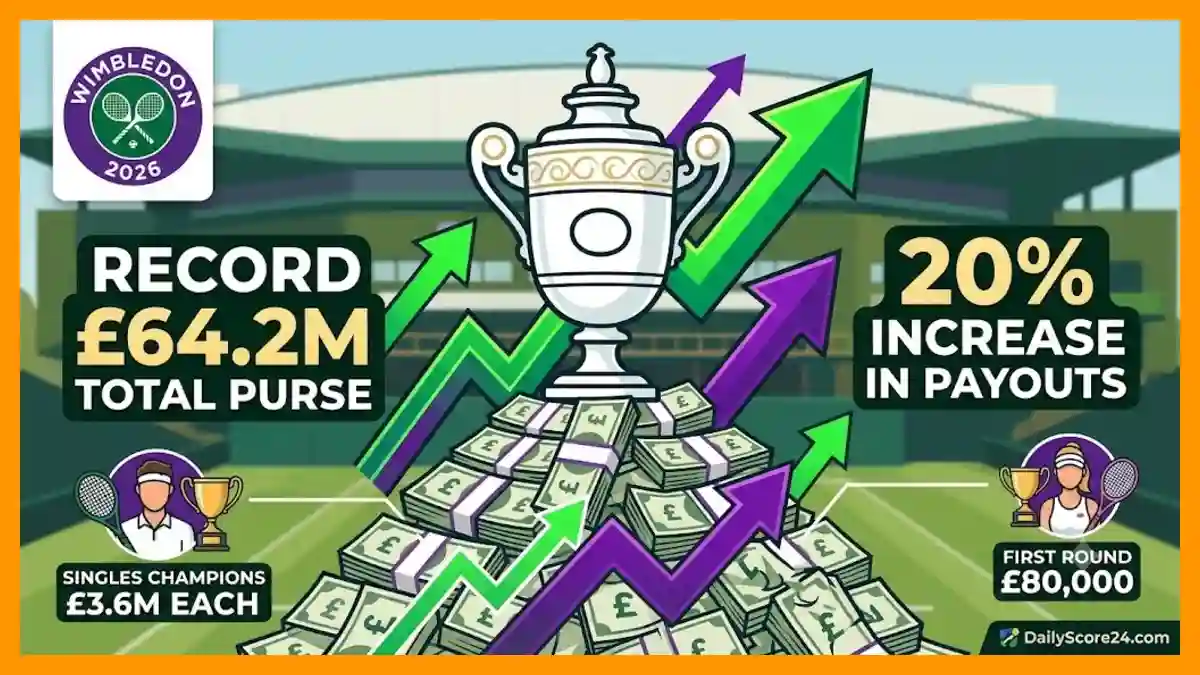
The official release of the tournament financial distribution data highlights a major shift in the professional tennis tournament financial structure, driven by the record-breaking Wimbledon 2026 total purse increase. This historic 20% expansion directly reshapes tennis grand slam financial payouts, offering substantial adjustments to tennis player championship payout statistics and Wimbledon player salary compensation details. At the pinnacle of the event, the ladies singles winner earnings 2026 match the men’s at £3.6 million, while the first round loser prize money Wimbledon reaches a record £80,000. Supported by strong All England Club revenue growth, this compensation reset addresses intense global debates surrounding professional tennis player revenue distribution.
The financial adjustments at the 139th edition of the Wimbledon Championships directly impact elite competitors on the lawns of London. Defending men’s singles champion Jannik Sinner and finalist Alexander Zverev play for unprecedented stakes at Centre Court. On the women’s side, Linda Nosková secured her historic title against Karolína Muchová under identical financial rewards. The strict equal prize money protocol enforces equal financial returns for both draws across every round of the tournament. Beyond the headline figures, the broader player community, including qualifying competitors and doubles partnerships, experiences a structural lift in financial rewards.
Analysis of the Tournament Financial Distribution Data
The structural core of the 2026 championships rests on a record-breaking total pool of £64.2 million. This total represents an absolute increase of £10.7 million over the £53.5 million distributed during the 2025 tournament. Historical analytics show this to be the single largest annual financial expansion in the history of the event, following an 11.86% increase in 2024 and a 7.0% increase in 2025.
The All England Lawn Tennis and Croquet Club distributes these funds meticulously down the line of performance. While championship-level performers see a raw increase of £600,000 compared to 2025, the percentage-based growth is distributed heavily toward early-round participants. This methodology aims to alleviate the high operational overhead faced by lower-ranked touring professionals.
2026 Singles Tournament Financial Distribution Data
The following table outlines the exact progression of financial rewards for the men’s and women’s singles main draws in 2026:
| Performance Round | Prize Money (£ GBP) | Approximate Prize Money ($ USD) | Percentage Change vs 2025 |
| Winner | £3,600,000 | $4,830,756 | +20.00% |
| Runner-up | £1,800,000 | $2,415,378 | +18.42% |
| Semifinalist | £900,000 | $1,207,689 | +18.42% |
| Quarterfinalist | £480,000 | $644,101 | +17.07% |
| Fourth Round | £300,000 | $413,000 | +11.11% |
| Third Round | £185,000 | $255,000 | +10.78% |
| Second Round | £126,000 | $173,000 | +14.55% |
| First Round | £80,000 | $110,000 | +21.21% |
Evaluating the Professional Tennis Tournament Financial Structure
The allocation of prize money across grand slams has long been a subject of scrutiny regarding sports betting trends and player contract valuation. In a sport devoid of guaranteed team-funded salaries, players function as independent contractors. Consequently, tournament financial distribution data serves as the primary mechanism for player compensation, determining the economic viability of a professional tennis career.
The 21.21% increase applied to the first round loser prize money Wimbledon bracket marks a deliberate attempt to stabilize the lower tiers of the professional circuit. Earning £80,000 for an opening-round appearance ensures that even players who exit on day one can cover their annual coaching, travel, and training expenses. This structural emphasis helps cultivate a more sustainable ecosystem for international tennis development.
The qualifying competition also benefits from targeted financial reassessments, with its total pool rising 25% to £6.2 million. Players eliminated in the third qualifying round receive £50,000, while those exiting in the first round take home £20,000. These secondary lines of financial distribution protect athletes who operate outside the elite top-100 rankings.
Wimbledon Player Salary Compensation Details and Main Draw Economics
For the top-tier competitors, the tournament financial distribution data confirms a highly lucrative fortnight. The ladies singles winner earnings 2026 payout of £3.6 million represents a dramatic increase from historical baselines. When compared globally, the United States Open remains the wealthiest single tournament pool, having distributed $90 million in total rewards previously, but Wimbledon’s 2026 expansion sharply narrows that competitive gap.
Doubles specialists also witness upward movements in their structural compensation frameworks. The men’s and women’s doubles champions divide a pool of £760,000, which marks an 11.76% elevation from previous baselines. The mixed doubles winners secure a combined sum of £148,000, maintaining the historical hierarchy of grand slam financial distribution.
Comparative Main Draw Doubles Allocations
Winners: £760,000 per pair (+11.76%)
Finalists: £380,000 per pair (+10.14%)
Semifinalists: £190,000 per pair (+8.57%)
Quarterfinalists: £95,000 per pair (+8.57%)
All England Club Revenue Growth and the Global Player Dispute
Despite the record-setting expansion of the tennis grand slam financial payouts, the underlying figures continue to fuel structural tension between elite athletes and tournament directors. Financial ledgers indicate that the record £64.2 million prize fund represents approximately 15.2% of the All England Club’s £426.9 million revenue from the previous fiscal cycle. This model contrasts sharply with other major sports leagues globally.
In corporate professional leagues such as the National Football League and the National Basketball Association, collective bargaining agreements guarantee athletes a revenue share close to 50%. Even within tennis, ATP Tour and WTA Tour 1000-level events distribute approximately 22% of their gross revenue back to the competing field. This variance forms the basis of an ongoing legal and administrative dispute between player advocacy groups and Grand Slam administrators.
During the preceding French Open, an organized coalition of elite players formally petitioned for a minimum 16% revenue share for the 2026 London championships. Had the All England Club conceded to that specific margin, the total prize fund would have scaled to approximately £71 million. While the delivered £10.7 million increase reduces the discrepancy, it does not fully align with the long-term targets established by player labor representatives.
The Broader Context of Tennis Grand Slam Financial Payouts
The evolution of professional tennis tournament financial distribution data reflects a broader commercial boom in league media rights and global sponsorship impact. The financial architecture of the four majors relies heavily on broadcast partnerships, corporate ticket packaging, and international merchandising. As tournament revenues surge, the pressure to pass those gains down to the competitive field intensifies.
The modern paradigm requires balancing infrastructure investment with immediate athletic compensation. The All England Club continuously defends its structural model by noting that surplus revenues do not simply sit in reserve. Instead, these funds are directly reinvested into extensive facility upgrades, the preservation of the grass-court season, and grassroots development via British and international tennis federations.
Nevertheless, the economic divide between the sports’ elite and its rank-and-file players remains an urgent topic for performance analytics. By utilizing tournament financial distribution data to bolster the early rounds, tennis executives hope to preserve tournament integrity while maintaining the premium allure of the championship rounds.
Stay sharp with Daily Score 24!